


Sleep expert Greene appointed Professor Emeritus of Psychiatry

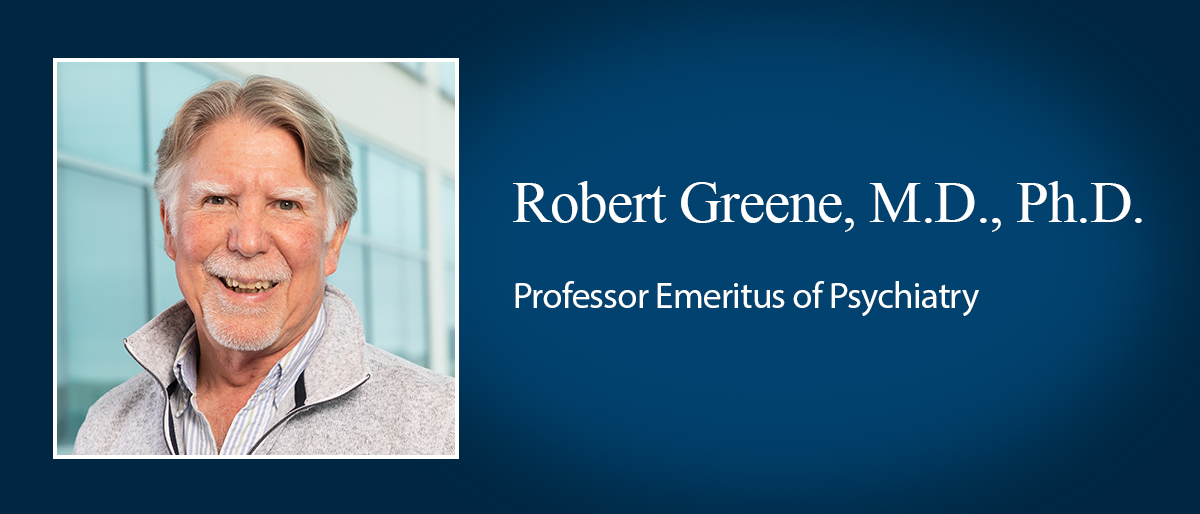
Sleep – not just the eight nightly hours he swears by, but its integral role in how the body functions – has long captivated Robert Greene, M.D., Ph.D.
Researching it has taken him all over the world, leading to publishing a plethora of papers that have generated 14,000 citations. His work in Switzerland, in Japan, and at Harvard and other universities has distinguished him as an international expert, earning him multiple honors and affiliations within the neuroscience community.
Yet his heart remains firmly loyal to the place that welcomed him almost a quarter century ago.
“I’d be hard-pressed to find any place that could compete with UT Southwestern as providing the most wonderful scientific environment you can find,” said Dr. Greene, who retired last year as Professor of Psychiatry and Neuroscience and was subsequently appointed Professor Emeritus of Psychiatry.
Initially, he had doubts about moving to Texas. Born and raised in Annapolis, Maryland, he and his family are, he said, “East Coasters. I’m from salt water.”
But when former Chair of Psychiatry Eric J. Nestler, M.D., Ph.D., asked Dr. Greene to come down for an interview for a faculty position, “I was nothing but bowled over,” he recalled. “There’s a reason UT Southwestern has such a great and well-deserved reputation.”
Initially hired in 2001 as Associate Chief of Staff for Mental Health, Veterans Administration North Texas, he also served as Vice Chair of UT Southwestern’s Department of Psychiatry. He then moved full time to UTSW to focus on sleep research, which included characterizing mechanisms responsible for pathologies associated with disruption of sleep/wake states such as autism spectrum disorder, schizophrenia, drug addiction, post-traumatic stress disorder, and traumatic brain injury.
“I interacted with people from the Neuroscience, Molecular Science, Biochemistry, Pharmacology, and Cell Biology Departments,” Dr. Greene said. “There was a lot of synergistic interaction going on.”
Initially, philosophy rather than sleep was his primary interest, which he pursued as a major at Kenyon College in Ohio. There, Dr. Greene decided he wanted to understand how and why the brain supports consciousness. Sleep, he decided, would be a way to get at that question.
“I wanted to understand why we sleep – perhaps the default state – and why we bother to wake up,” he said.
His interest in sleep intensified. While working on his Ph.D. at George Washington University, he also enrolled at the University of Maryland School of Medicine to earn his medical degree. After completing both degrees, he moved to Switzerland to deepen his neurological knowledge and further his research.
The study of sleep has changed dramatically since those early days. Still, he said, “It remains one of the premier enigmas of all science: Why do we spend time asleep?”
Answering that question takes an understanding of how neurons interact at a cellular level. “Sleep has a profound effect on how the brain behaves,” Dr. Greene said. “Before, we didn’t have a clue. Time spent sleeping seemed like a waste.”
But continued research has shown otherwise. “Although you might not be conscious of the cellular changes occurring during sleep, you work better and feel better because you’ve slept,” he said. “Sleep helps to fine-tune, recover, and reset your system from the demands of the previous day. It’s a very complex system.”
His team’s work through the decades has been groundbreaking.
“We were studying the brain to understand how local neuronal networks communicated, and the implications those had for brain disease and particularly for sleep’s role,” Dr. Greene said. “We found that every time you go to sleep, there are changes in the way the cells in your brain express their DNA, which affects their function.”
William Dauer, M.D., Director of the Peter O’Donnell Jr. Brain Institute and Professor of Neurology and Neuroscience, knows Dr. Greene as both a scientific colleague and friend. Since they met in 2019, the two have worked together and participated in neurological seminars. Twice, they’ve gone on group fly fishing trips to remote parts of Alaska.
“He’s very passionate about fly fishing and maybe a bit competitive,” Dr. Dauer said.
He’s seen that passion on a professional level as well, particularly when Dr. Greene talks about synaptic plasticity, which he studied in various contexts over his career.
“He’s always asked challenging, spot-on, meaningful questions,” Dr. Dauer said. “That’s the kind of faculty member you want around, those who are engaged, who ask those questions, who participate. He always had a smile on his face.”
He always looked forward to seeing Dr. Greene on campus. Now, Dr. Dauer said, “I miss him totally, especially at the seminars. There’s a void, that’s for sure.”
These days, Dr. Greene spends most of his time in Rhode Island, sailing in his beloved salt water. While he misses the day-to-day interactions, he’s proud of the legacy he’s left behind.
“We made important advances in understanding sleep, and I’ve had a significant role in that,” he said. “I’d like to be remembered for the work I’ve done here, and the impact it’s had on the human condition.”
Endowed Title:
Dr. Dauer holds the Lois C.A. and Darwin E. Smith Distinguished Chair in Neurological Mobility Research.