


President’s Lecture Series: Delving into the sex lives of schistosomes

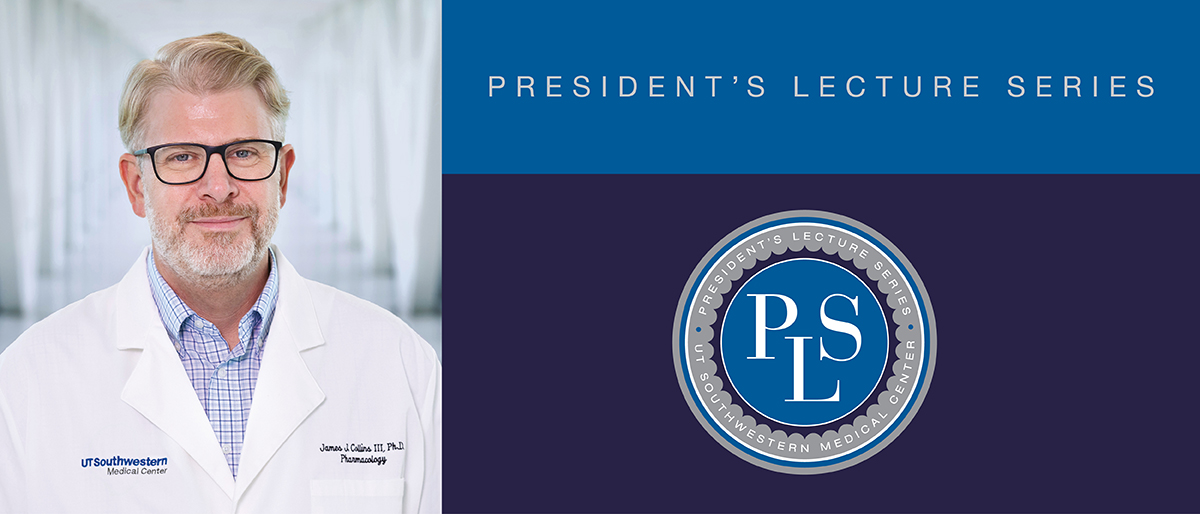
Each year, nearly a quarter of a million people in South America, Asia, and sub-Saharan Africa die from schistosomiasis, a parasitic disease tied to flatworms. Because this disease affects mostly impoverished people, there’s little financial incentive for pharmaceutical companies to study these organisms. But research at UT Southwestern by James Collins, Ph.D., Professor and Interim Chair of Pharmacology, is filling the gap, revealing mechanisms that could lead to new ways to fight and prevent this neglected tropical disease.
Come learn more on Sept. 17 as the President’s Lecture Series kicks off the 2026-27 academic year with Dr. Collins presenting “You Complete Me: The Secret Lives of Schistosomes.”
Schistosomes are parasitic flatworms that grow in some species of freshwater snails and enter the bloodstream of humans who come into contact with contaminated water. After burrowing through the skin, females prolifically lay eggs – one or more every five minutes – that lodge within tissues and organs, causing debilitating inflammation and scarring that damages the liver, intestines, lungs, and bladder.
“Schistosomiasis not only affects people who are poor, it keeps them poor by preventing them from living up to their full potential,” Dr. Collins said. “If we can figure out a way to block schistosome egg production, we’d completely eliminate all disease pathology and blunt disease spread.”
Dr. Collins has made many discoveries about schistosome basic biology. One of the most impactful findings so far, published in Cell in 2022, answered a century-old mystery by identifying a molecule called β-alanyl-tryptamine produced by male parasitic worms that prompts sexual maturity in females.
Recent research in the Collins Lab is seeking to uncover how male schistosomes know that females are in physical contact, how males turn on β-alanyl-tryptamine production and release it, how females receive it, and what subsequent signaling leads to female sexual maturity. Blocking any portion of this pathway could stop egg production and, by extension, schistosomiasis, he explained.
“Short-circuiting this biological process in either male or female schistosomes could lead to the therapy that millions of people worldwide have been waiting for,” Dr. Collins said.
Endowed Titles
Dr. Collins holds the Jan and Bob Bullock Distinguished Chair for Science Education and the Jane and Bud Smith Distinguished Chair in Medicine and is a Rita C. and William P. Clements, Jr. Scholar in Biomedical Research.