


Piper Professor Award honors pediatric anesthesiologist Ambardekar

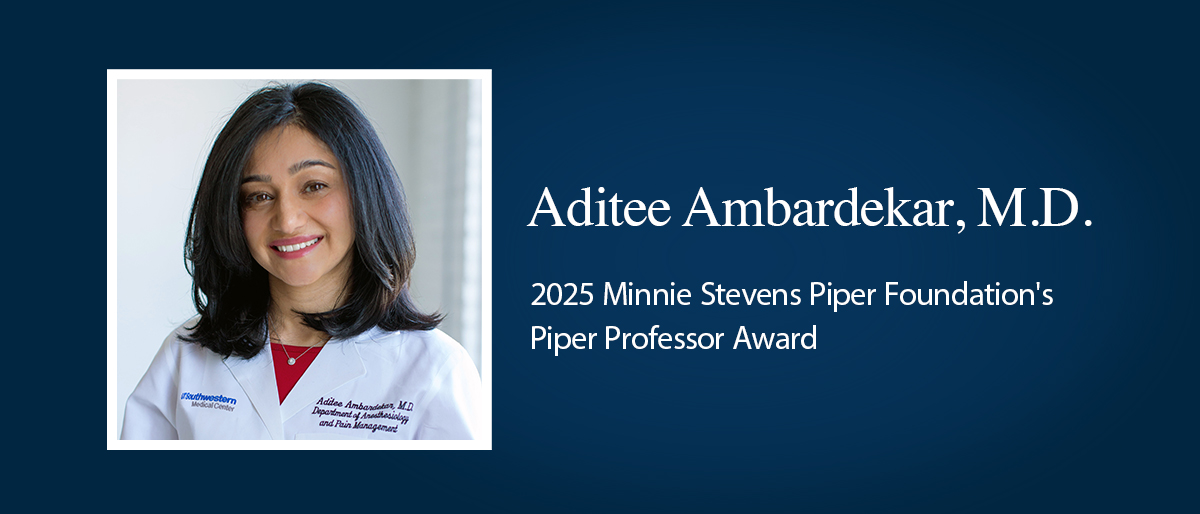
Pediatric anesthesiologist Aditee Ambardekar, M.D., finds treating children rewarding because they tug at her heart with their honesty and humor.
“It’s meaningful, impactful work,” she said. “Taking care of kids feels like I am investing in the next generation.”
Her drive to have an impact extends far beyond her young patients. Dr. Ambardekar, Professor of Anesthesiology & Pain Management and a Distinguished Teaching Professor, is also dedicated to making a difference for future generations of physicians.
“Teaching residents, knowing they will go on and have an impact on their patients, is important to me,” she said. “This is my way of having an impact.”
Dr. Ambardekar’s expertise and dedication were recently recognized by the Minnie Stevens Piper Foundation with a Piper Professor Award, which honors outstanding college educators in Texas. Dr. Ambardekar is the 20th current or former UTSW faculty member to receive the award since its creation in 1958.
Each year, 10 Piper Professor Award winners are chosen for superior college-level teaching, based on nominations submitted by Texas colleges and universities. Winners receive a $5,000 award.
“I can think of no better recipient of the Piper Professor Award,” said Stephen Kimatian, M.D., Chair of Anesthesiology & Pain Management. “Whether it is here at home where she serves as Program Director for our core residency in anesthesiology, or nationally in her work with the Accreditation Council for Graduate Medical Education and American Board of Anesthesiology, Dr. Ambardekar is the consummate medical educator.”
Born in India and raised in Maryland, Dr. Ambardekar knew early on she wanted a career in medicine.
She earned her medical degree at the University of Maryland School of Medicine and completed a residency in anesthesiology at the University of Pennsylvania. Dr. Ambardekar then received advanced training in pediatric anesthesiology through a fellowship at Children’s Hospital of Philadelphia. Pediatric anesthesiology was a perfect fit, she said.
“I didn’t have an aha moment. It was very intentional,” said Dr. Ambardekar, who cares for patients at Parkland Memorial Hospital and Children’s Medical Center Dallas. “As a pediatric anesthesiologist, you draw on the full breadth of your medical knowledge, use your hands in the operating room, and need to build relationships and trust quickly. It is a rewarding combination of things.”
Before coming to UT Southwestern, she was an Assistant Professor at the Perelman School of Medicine at the University of Pennsylvania. At Children’s Hospital of Philadelphia, she directed the pediatric anesthesiology fellowship and developed a simulation-based education program. The work ignited a passion for teaching that would become a hallmark of her career. Encouraged by her mentors, Dr. Ambardekar earned a master’s degree in education from the Graduate School of Education at the University of Pennsylvania.
“As physicians, we are expected to teach everyone around us – residents, patients, families,” she said.
In 2014, Dr. Ambardekar joined UT Southwestern, where she focused on revamping the anesthesiology curriculum for undergraduate medical education. She also played a key role in supporting graduate medical education and continuing medical education.
Over her career, she has learned to balance her passion for education with her clinical practice, spending 40% of her time in the operating room. Dr. Ambardekar also conducts clinical research on how best to care for burn-injured children under anesthesia with the hope that her work will inform future anesthesiologists.
“Pediatric anesthesiology is very challenging, but also rewarding,” she said. “You’re taking care of patients at some of their most vulnerable times.”
Teaching residents presents a different challenge, said Dr. Ambardekar, who has led a residency program to train 89 residents since 2018. “As academic anesthesiologists we teach, we guide, we give feedback and push residents to learn, all while keeping our patients safe,” she said. “The training is tough for a reason. You must think on your feet and make very difficult decisions. You need solid educational training to make those split-second decisions.”
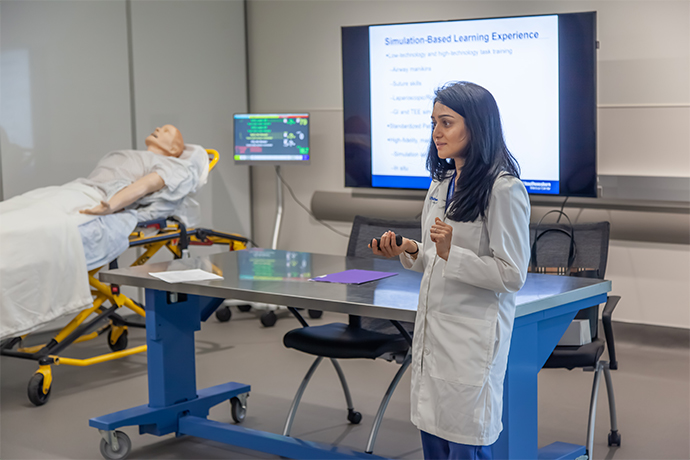
Dr. Ambardekar has been involved in the Department’s and institution’s simulation programs, where students, residents, and faculty learn skills in a psychologically safe environment. “Simulation made teaching fun for me and I became a better doctor,” she said. “The simulation lab is a safe place to learn. It is OK to make mistakes there.”
Whether in the operating room or simulation lab, Dr. Ambardekar is committed to educating others, so receiving the Piper Professor Award is incredibly special, she said. “When you find work that makes a difference, you want to work harder,” she said. “For me, this is my work; it is what I love to do.”
Endowed Titles
Dr. Kimatian holds the Margaret Milam McDermott Distinguished Chair in Anesthesiology and Pain Management.