


Olson strikes inspiring chords in musical keynote at Graduate School commencement

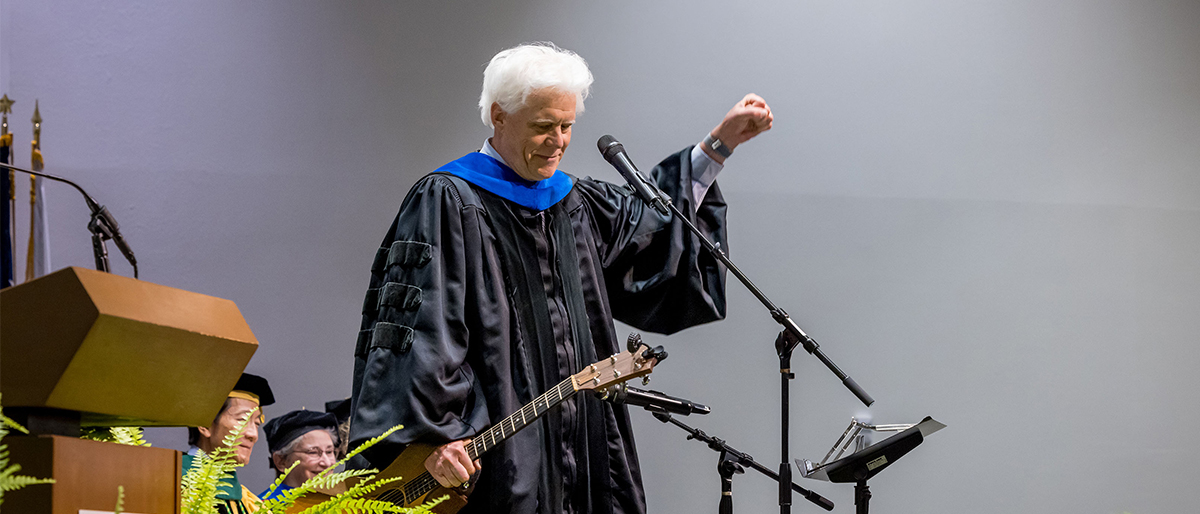
A few months ago, Eric Olson, Ph.D., founding Chair and Professor of Molecular Biology, was asked to give the keynote address at the 2026 commencement for the UT Southwestern Graduate School of Biomedical Sciences. The request came directly from UTSW President Daniel K. Podolsky, M.D., so, naturally, Dr. Olson graciously accepted.
Watch: Dr. Olson performs original song at commencement
- Full Transcript of Video: Eric Olson, Ph.D., Performs Original Song at Graduation
Dr. Eric Olson: The song is called “Find Your Way.”
[acoustic guitar and harmonica played together to open song]
[singing and playing acoustic guitar]
They hand you a paper. They shake your hand.
But there ain’t no map to the promised land.
The road ahead is a mystery.
Tomorrow won’t wait for certainty.[singing and playing acoustic guitar]
Find your way, when the path’s not clear.
Follow your compass, drop your fear.
Let the doubters talk, let the years roll on.
Only you decide, where you belong.
When the moment comes and the band starts to play …
Find your way.[singing and playing acoustic guitar]
If there’s a voice in your head saying,
“I’m not ready. My hands are shaking, ground’s unsteady.”
The only way through is to take a chance.
Step into the light. Take your stance.[acoustic guitar and harmonica played together]
[singing and playing acoustic guitar]
Find your way.
When the road’s unknown.
Trust the courage that you’ve grown.
Let the questions come, let the answers change.
Draw your map on an empty page.
When the moment comes and it calls your name.
Find your way.[singing and playing acoustic guitar]
Listen to the music.
When it comes your way, become who you are.
Find your way.[acoustic guitar played first, then harmonica added at end of song]
[Audience applause.]
[Dr. Olson bows twice]
Congratulations, Class of 2026!
But he had his own request.
“I said I’d also like to do something out of the ordinary – not just a standard commencement speech,” Dr. Olson said. “I told him I’d like to write a song and play it.”
Dr. Podolsky agreed, and on May 21, in front of graduating students gathered with families, friends, and faculty inside the Tom and Lula Gooch Auditorium for the ceremony, Dr. Olson began with an emboldening speech. Then he strapped on one of his acoustic guitars, pulled his harmonica harness over his head, and surprised the graduates with a memorable musical sendoff.
Titled “Find Your Way,” the song linked back to the themes of his keynote.
After the opening guitar chords came a plaintive harmonica riff tinged with shades of Neil Young’s 1972 classic “Heart of Gold,” followed by Dr. Olson’s earnest, storytelling vocals.
They hand you a paper. They shake your hand.
But there ain’t no map to the promised land.
The road ahead is a mystery.
Tomorrow won’t wait for certainty.Find your way, when the path’s not clear.
Follow your compass, drop your fear.
Let the doubters talk, let the years roll on.
Only you decide, where you belong.
When the moment comes and the band starts to play …
Find your way.
When the nearly three-minute reflective ballad ended, Dr. Olson received enthusiastic applause, took a bow and said, “Congratulations to the Class of 2026” with a couple of fist pumps.
In the days and weeks since, Dr. Olson’s performance has continued to be the talk of campus.
“It was a smash hit with all my friends and family,” said Ryan Beckner, a student in the Perot Family Scholars Medical Scientist Training Program (MSTP) who completed his Ph.D. in biological chemistry and is entering his final year of medical school. “Dr. Olson’s song and performance clearly supported his message of finding one’s path and following it through.”
“Science teaches us precision, persistence, and discovery. Music teaches us emotion, connection, and joy. Eric Olson brought both worlds together beautifully,” added Mateusz Durbacz, Ph.D., who received his doctorate in genetics, development, and disease with Dr. Olson as one of his two mentors. Dr. Durbacz was among 108 summer and fall 2025 and spring 2026 graduates recognized at the ceremony, 75 of whom attended in person.
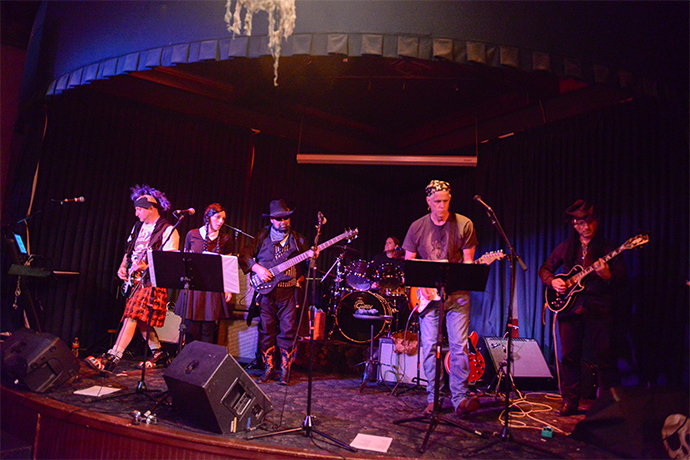
Dr. Olson is no stranger to the big stage – in science or music. The 2025 recipient of the Louisa Gross Horwitz Prize for his groundbreaking discoveries in muscle development and Duchenne muscular dystrophy (DMD) has performed countless times with The Transactivators, the rock band he started with UTSW colleagues about 20 years ago. (It’s named after a gene regulatory protein.)
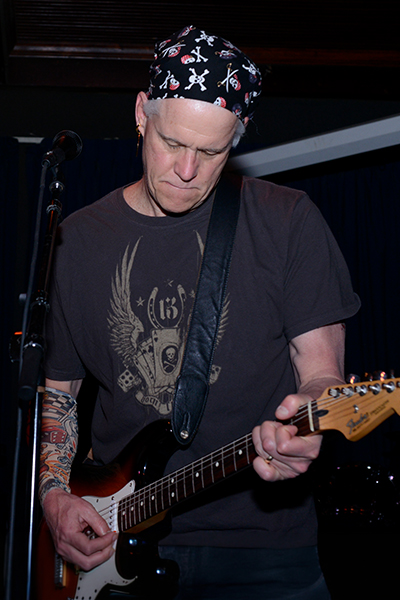
He has also performed with country music legend Willie Nelson, who, along with his wife, Annie, has generously supported the internationally recognized work of the Olson Lab.
But performing at a commencement? This was a new gig altogether.
“To be honest, I was pretty nervous about it, because I didn’t really know if I could pull this off,” Dr. Olson said. “I was very happy I didn’t fall on my face. I’m glad I faced up to my uncertainty and just did it. And of course that was the theme of my speech. So, I felt like if that’s the theme, I’m going to end it by illustrating that: Face your uncertainty and go for it.”
He added, “The most impactful songs provide personal meaning to the listener. While my commencement song was directed toward graduates and their paths ahead, I hope the song has a broader meaning for anyone facing the unknown, including the patients and families on the journey that is Duchenne.”
An early music foundation
Dr. Olson, one of the world’s top researchers in regenerative medicine and gene editing, comes from a musical family. While his father was a chemist and entrepreneur, his mother and grandmother taught piano and music theory at the Eastman School of Music in Rochester, New York, where Dr. Olson was born. His introduction to music was playing piano under that “very rigorous” tutelage, and he later played trumpet throughout high school.
After college, inspired by Bob Dylan, Dr. Olson taught himself to play guitar and harmonica. He’d always wanted to be in a band but got “sidetracked” by school and science: He earned a B.A. in chemistry and biology and a Ph.D. in biochemistry at Wake Forest University, then did postdoctoral work at Washington University School of Medicine. His first faculty position was at UT MD Anderson Cancer Center, where he later became Chair of Biochemistry and Molecular Biology.
A band never seemed to fit into the equation, but that changed at UTSW, where Dr. Olson met fellow researchers who also were musicians. Their jam sessions grew into The Transactivators, a rock band that also drew inspiration from the music of Willie Nelson.
In fact, Dr. Olson shared with the graduates one of his most defining moments – the day he played harmonica with Willie & Family at Dos Equis Pavilion in Dallas on July 2, 2022. He was invited onstage late in the concert, and he looked right at home in front of about 20,000 spectators – including his wife, retired pediatrician Laurie Clark, and their three adult children.
“There was no rehearsal. Just a vague instruction to play when I got ‘the signal’ – except I wasn’t sure what songs we’d be playing or what the signal would be,” Dr. Olson told the graduates. “I had the same question all of you will face in your lives: Am I ready? Then the music started. And I realized something: You don’t find your way by waiting and worrying. You find your way by playing the notes in front of you – right now. So, I took a breath. And I played. And in that moment, I found my way.
“The most meaningful opportunities in your life won’t come with instructions. They will ask you to trust yourself before you feel fully ready – and start playing.”
Endowed Titles
Dr. Olson holds the Pogue Distinguished Chair in Research on Cardiac Birth Defects, The Robert A. Welch Distinguished Chair in Science, and the Annie and Willie Nelson Professorship in Stem Cell Research.
Dr. Podolsky holds the Philip O’Bryan Montgomery, Jr., M.D. Distinguished Presidential Chair in Academic Administration and the Charles Cameron Sprague Distinguished Chair in Biomedical Science.