


‘FEARless’ research leads to Nominata Award
Graduate student uncovers a new pathway, FEAR, that restricts virus replication


Since its discovery in 1957, the interferon response pathway has been considered the primary way that mammalian cells fight off viruses. But over the past five years, work led by graduate student Emily Rex has revealed a previously unknown pathway that appears to broadly fight viruses across at least five unrelated families. Named the FACT-ETS-1 Antiviral Response, or FEAR, this newly found pathway appears to be present in many organisms, including humans, insects, and worms – suggesting that it may be evolutionarily much older than the interferon response.
This paradigm-changing research was published in the high-impact journal Nature Microbiology and has earned Ms. Rex the 2026 Nominata Award, the highest accolade bestowed on a UT Southwestern Graduate School of Biomedical Sciences student. This honor is the latest for the fifth-year student in the Molecular Microbiology Graduate Program, whose work on FEAR has previously been recognized with a National Institutes of Health grant and two other scholarships.
Managing a virology lab

Before starting graduate school, Ms. Rex worked as a lab manager for Don Gammon, Ph.D., Associate Professor of Microbiology, moving there after amassing previous lab manager experience at Oregon Health & Science University.
Over the next four years, Ms. Rex contributed immeasurably to the Gammon Lab’s success in virology research. Her intellect, drive, and ability to master both technical and “soft” research skills made her an excellent candidate as a graduate student, Dr. Gammon said. With his encouragement, Ms. Rex applied to and was accepted at UTSW’s Graduate School. After rotations in other labs, she committed to the Gammon Lab to continue work she’d begun there.
That research focused on a curious phenomenon that Dr. Gammon had studied: Viruses that don’t typically replicate in moth cells did so readily when co-infected with vaccinia virus, a poxvirus that usually infects vertebrates. Genetic manipulations showed this effect was due to a poxvirus protein called A51R that appeared to act as an immune evasion protein to help these viruses counter cellular antiviral defenses. It was unclear why a mammalian poxvirus protein would be capable of inhibiting antiviral responses in insect cells.
Dr. Gammon hypothesized that poxvirus A51R proteins were likely inhibiting an antiviral defense that is common between insect and mammalian hosts. However, the nature of this antiviral response and the mechanism by which A51R blocked this response was unknown.
Going deep into FEAR
To seek answers, Ms. Rex looked for proteins in mammalian cells that bind to A51R. Experiments showed that A51R attached to Spt16, a protein known to join with another cellular protein (SSRP1) to form a unit called the FACT complex. Further experiments showed that when A51R was present in cells, it prevented this complex from forming, blocking it from inducing ETS-1 (an antiviral transcription factor) – and consequently preventing it from performing its job in antiviral immunity.
Although the FACT complex had never been connected to transcription-dependent antiviral immunity, further experiments showed that the genes it regulates through ETS-1 have antiviral functions. Subsequent research since Ms. Rex and her colleagues’ initial discovery of the FEAR pathway in 2024 has shown that it is effective against both DNA and RNA viruses from families including Poxviridae, Rhabdoviridae, Paramyxoviridae, Togaviridae, and Orthomyxoviridae.
“Incredibly, Emily has not only discovered an entirely new arm of innate antiviral immunity, but her work has also revealed multiple mechanisms by which unrelated viral pathogens evade the FEAR pathway, fundamentally changing our understanding of the evolutionary battle between viruses and their host,” Dr. Gammon said.
After defending her dissertation this fall, Ms. Rex hopes to find a postdoctoral position where she can continue studying viruses to determine their hosts’ biology. She dreams of eventually running her own virology lab.
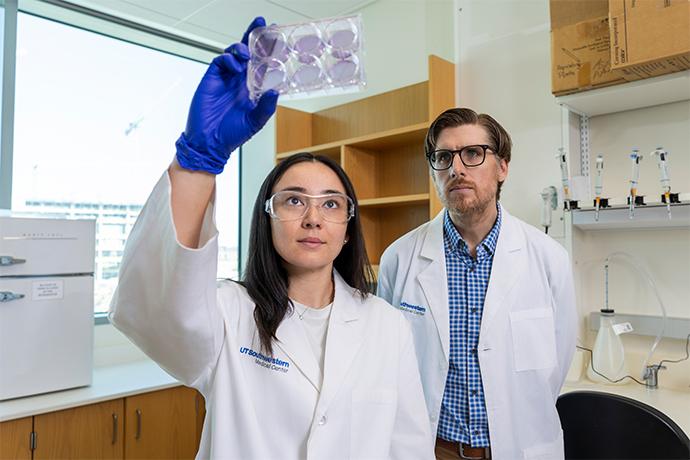
“Academic science really takes a village and lots of collaboration and collegiality,” she said. “I’m really thankful and grateful for everybody throughout my life who has contributed to my work.”
The Nominata Award was established in 1980 by the Graduate Student Organization to promote academic excellence and research achievement. The winner receives a monetary award and presents their research to the UT Southwestern community. As part of the University Lecture Series, Ms. Rex gave her Nominata lecture on April 15 in the NG3 Auditorium.
Nominata finalist Dohun Kim, a senior Ph.D. student in the Cancer Biology Graduate Program, received a Dean’s Discretionary Award. His research in the lab of Gerta Hoxhaj, Ph.D., Assistant Professor in Children’s Medical Center Research Institute at UT Southwestern (CRI), Biochemistry, and Pediatrics, focuses on the contribution of a coenzyme called NADPH and nucleotide metabolism to cancer development and progression. Mr. Kim’s research has been published in high-impact journals, including Nature Cell Biology and Cell.
Endowed Titles:
Dr. Gammon is a W.W. Caruth, Jr. Scholar in Biomedical Research.