


MSTP student receives Kirkpatrick Award for cancer immunity research


When she was a child, Emma Parks thought she wanted to become a teacher, then a physicist, and, later in college, an engineer. But along the way, she often felt drawn to medicine.
“At some point I knew I really wanted to make a tangible difference,” she said. “There’s just so much suffering and disease; I wanted to help people as much as possible.”
With that new goal in mind, Ms. Parks eventually became a Perot Family Scholars Medical Scientist Training Program graduate student at UT Southwestern. Recently, her passion for medical research led to her recognition as the 2026 William F. and Grace H. Kirkpatrick Award recipient. Her immunology project, “Tryptophan-derived oncometabolites as novel mediators of cancer immune evasion,” was chosen from among 15 eligible submissions.
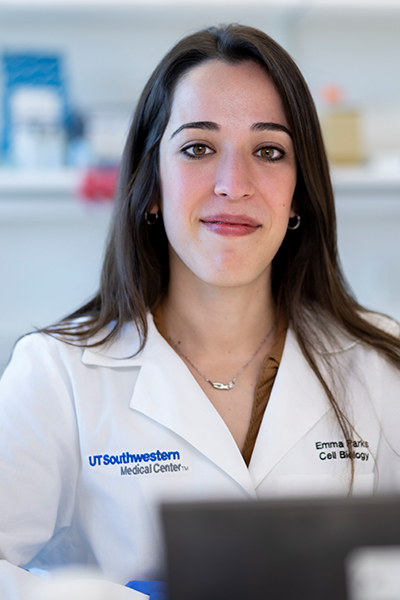
The William F. and Grace H. Kirkpatrick Award is given annually to a graduate student who submits the most scientifically meritorious National Institutes of Health “F” series or equivalent fellowship grant application during the prior academic year, as judged by the Southwestern Graduate School (SGS) Awards Committee.
The award for Ms. Parks’ work provides $25,000 to the lab of Maralice Conacci-Sorrell, Ph.D., Associate Professor of Cell Biology and in Children’s Medical Center Research Institute at UT Southwestern (CRI), to support the proposed research.
Ms. Parks was introduced to UTSW in 2019 as a participant in Amgen Scholars, an undergraduate summer research program in which students conduct research, attend seminars, and take part in a symposium. Ms. Parks studied nanoparticle-mediated cancer immunology.
“At that time, I was already pretty sure that I wanted to go into immunology, and my experience only solidified that feeling,” Ms. Parks said.
The summer program became a big part of the reason she came to UT Southwestern in 2020. She joined the Sorrell Lab, which focuses on tumor metabolism. As she worked in the lab, Ms. Parks’ fascination with immunology grew.
“Part of it is because it is such an expansive organ system that touches every part of the body,” Ms. Parks said. “It has such an impact, and yet it is invisible at the same time.”
She investigates how cancer cells use energy sources and nutrients to their own benefit. Sometimes cancer cells generate various nutrient breakdown products that can interfere with immune cell function, she explained.
“Normally the immune system would try to fight back against cancer and prevent it from growing,” Ms. Parks said. “My work focuses on how liver cancer promotes the generation of a metabolite called indole-3-pyruvate, or I3P, which prevents various immune cells from targeting the cancer the way we would like them to. Our hope is that this research can provide us with a greater understanding of the distinctive metabolic signatures and vulnerabilities of liver cancer.”
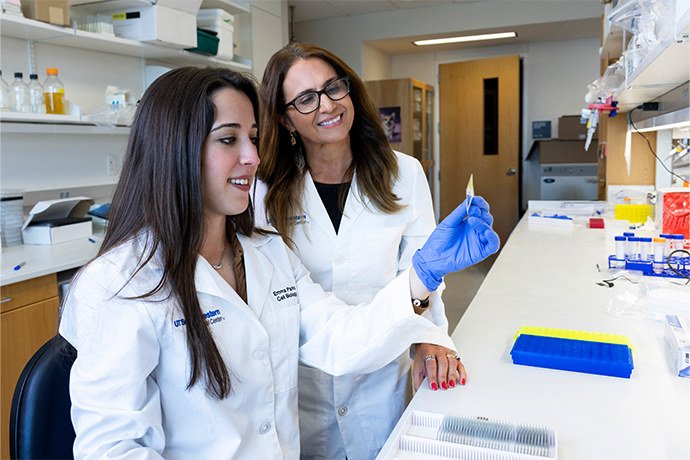
Dr. Conacci-Sorrell, also a member of the Harold C. Simmons Comprehensive Cancer Center, said Ms. Parks’ National Cancer Institute grant application was exemplary and scored in the top 1% of all applicants.
“Yet despite this achievement, she remains humble, generous, and supportive of her peers, helping them navigate their own challenges,” she said. “One can already see the outstanding independent scientist and trusted mentor emerging in Emma. I look forward to the important contributions she will make to science and to the trainees she will inspire along the way.”
As an MSTP student, Ms. Parks attended UT Southwestern Medical School for two years before transitioning to research for two years. This fall she will return to medical school to finish the program.
Ms. Parks said she enjoyed working in the lab but looks forward to returning to medical school and later doing her residency in internal medicine.
“My goal is to work in a public hospital because it is important to me to provide care for people regardless of their insurance coverage,” she said, adding that she hopes to combine research and clinical work. “It’s what feels right to me.”
Endowed Title
Dr. Conacci-Sorrell is a Virginia Murchison Linthicum Scholar in Medical Research.