


Jerry Shay, Ph.D.: 50 Years
A failed experiment to grow radiated radishes leads to a career of breakthrough discoveries

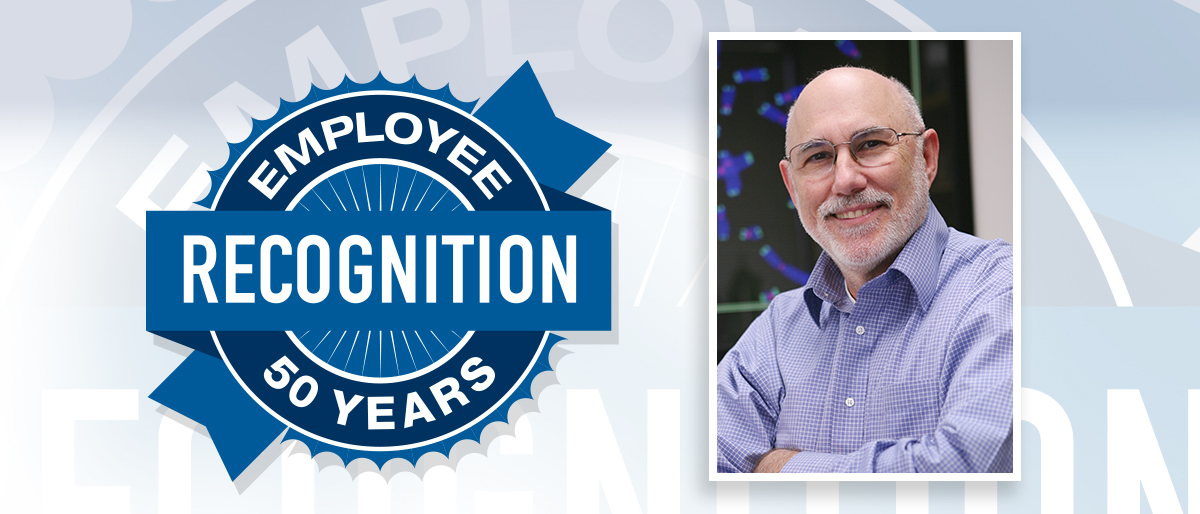
Jerry Shay, Ph.D.
Professor
Department of Cell Biology
When Jerry Shay, Ph.D., was growing up, he learned a valuable lesson about science – one that’s stuck with him throughout his long career. Looking for science fair project ideas, he read in a comic book about radioactive radishes that could grow to the size of watermelons. After mail-ordering some seeds, Dr. Shay decided to test this claim by planting a row of the radiated radish seeds next to a row of conventional radish seeds in his family’s Dallas backyard. Each week, he took a picture of the garden to compare growth between the rows. But one week, his neighborhood was hit with a hailstorm, decimating the plants and ruining his experiment.
“It taught me that science is complicated, and it’s hard to do experiments and get them to work every time,” he says. “The most important thing is to learn from experiments, no matter how they turn out.”
Dr. Shay has applied this principle repeatedly since he landed a tenure-track faculty position at UT Southwestern in 1975. Now a Professor of Cell Biology and a Distinguished Teaching Professor, Dr. Shay’s ability to follow his instincts and not be deterred by scientific setbacks has led to countless discoveries.
A few years after joining UTSW, Dr. Shay made a major breakthrough that set the course for much of his career. Working with colleague Woodring Wright, M.D., Ph.D. – who was recruited to UTSW in 1978 and was Dr. Shay’s close collaborator until his death in 2019 – Dr. Shay sought to understand why cultured cells undergo a limited number of cell divisions before they age and stop multiplying. Researchers at UTSW and elsewhere had just begun studying telomeres – DNA with repetitive sequences found at the ends of chromosomes that appeared to shorten with each cell division. Could this be the elusive counting mechanism cells use to determine when to stop dividing?
Drs. Shay and Wright investigated this idea by inserting into cells the gene that produces telomerase reverse transcriptase (TERT), an enzyme crucial for maintaining telomere length. Unlike cells that didn’t produce this enzyme, those with TERT continued to divide as youthful cells do, never getting old.
Their study, published in Science, also revealed that TERT – active during development in humans and turned off before birth – becomes reactivated in cancer cells, supporting their uncontrolled division. Based on this seminal discovery, Dr. Shay and investigators in his lab have published hundreds of papers related to telomeres over the years. Their research has also branched into other areas, including targeted strategies to treat colon cancer, and he has partnered with NASA to develop ways to protect astronauts from cosmic radiation.
When Dr. Shay first arrived at UTSW in 1975, he figured he might be here five years. Fifty years later, at age 80, he continues to publish important research, mentor students and trainees, volunteer in the community, and enjoy the scientific freedom that he says few other places can provide. Because of that, Dr. Shay has no plans to retire anytime soon.
“As long as my health is good and I still have interesting projects to work on,” he says, “I think I’m good for more years yet.”
Endowed Title
Dr. Shay holds The Southland Financial Corporation Distinguished Chair in Geriatrics.