


Orchard receives Burroughs Wellcome Fund award for viral lipid metabolism research

Every year, norovirus sickens about 685 million people worldwide. No medication exists to treat this highly contagious stomach bug, which spreads easily in settings ranging from cruise ships to classrooms.
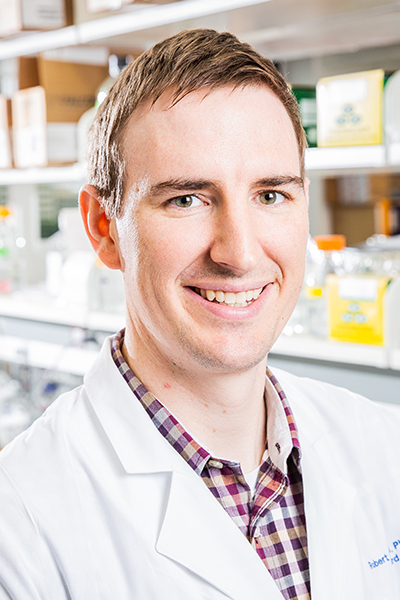
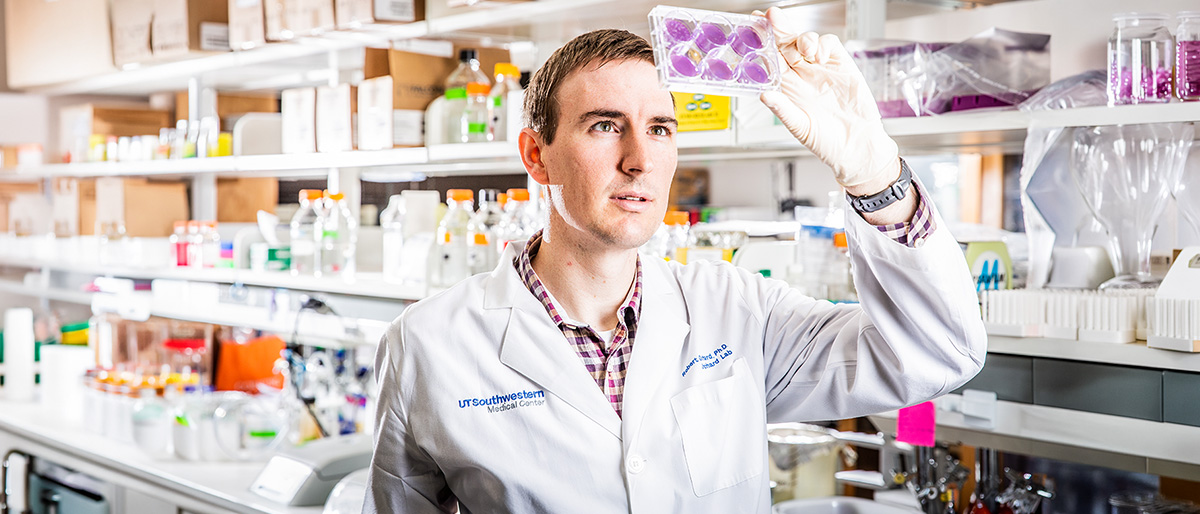
Robert Orchard, Ph.D., Associate Professor of Immunology and Microbiology, wants to change that.
“Our lab is interested in understanding how viruses like this make us sick,” Dr. Orchard said. “If we can understand that, then perhaps we can find ways to prevent them from infecting people.”
For his research on viral lipid metabolism genes, Dr. Orchard has received the Burroughs Wellcome Fund’s Investigators in the Pathogenesis of Infectious Disease Award. The $505,000 prize recognizes assistant professor-level scientists whose research advances understanding of infectious diseases. It is intended to provide investigators with the freedom to pursue novel ideas and establish independent research programs.
“There are so many notable UT Southwestern scientists that I have looked up to who have received this award, and now to be a part of that is very special,” Dr. Orchard said. “This empowers our lab to answer questions about different viral diseases with a lot of unknowns.”
Lora Hooper, Ph.D., Chair of Immunology, said she is thrilled to see Dr. Orchard’s innovative work recognized.
“This highly competitive honor reflects the importance of his research into how viruses, including noroviruses, enter cells, interact with their hosts, and overcome barriers to infection,” she said.
To describe his research, Dr. Orchard used the analogy of a virus as a traveler and the viral genome – the genetic material contained inside a virus particle – as the contents of a suitcase.
“When we travel, we typically only pack the essentials because we know that our host has many of the things we need,” he said. “We are interested in learning what these critical elements are in the viral genome. In other words, what does the virus think is so important to carry around all over the place in its suitcase?”
Most viruses pack materials needed for their replication. In particular, Dr. Orchard was struck by a group of viruses carrying a gene that modifies fat molecules. The gene is vPLATT, which stands for viral Phospholipase A Acyltransferase.
“Conventional thinking would suggest that this fat-modifying gene isn’t necessary for the virus,” he said. “It is analogous to a virus packing a mini-fridge into their suitcase.”
It is unknown why or how this gene works, he said. In general, fat-modifying genes have many functions, including organ development, inflammation, and suppressing tumors, Dr. Orchard added.
“Right now, we do not understand what type of fat this viral gene modifies or the specific modification that occurs,” he said. “By defining these molecular features, we hope to better understand why these viruses encode this gene.”
Meet the Minds: Robert Orchard, Ph.D.
As a boy growing up in Abilene, Texas, Dr. Orchard always had an interest in learning how things work.
“As a kid I hated to be sick and wondered how something so microscopic could make me so sick,” he said.
By high school, he was on track to become a researcher. Dr. Orchard graduated with a Bachelor of Science in microbiology from Texas A&M University, earned his Ph.D. in molecular microbiology at UT Southwestern, then pursued a postdoctoral fellowship at Washington University School of Medicine in St. Louis. In 2018, Dr. Orchard returned to UTSW to join the Department of Immunology as an Assistant Professor.
Unraveling why viruses cause disease is especially challenging because the market for antivirals is so insignificant compared with other diseases, he said. Anti-infectious agents frequently have a narrow range of pathogens they are effective against. Given this factor and the risk of drug resistance, Dr. Orchard said many major pharmaceutical companies have focused elsewhere.
That is why support from the Burroughs Wellcome Fund (BWF) is so important, he emphasized. Since 1981, BWF has funded modern molecular approaches to study and understand neglected diseases – such as tuberculosis, diarrheal diseases, and diseases transmitted by parasites – that primarily affect people in underdeveloped countries.
“It makes it possible for researchers to dream big,” Dr. Orchard said, “which can lead to new strategies to combat infections and diseases that affect millions of people.”
Endowed Titles
Dr. Hooper holds the Jonathan W. Uhr, M.D. Distinguished Chair in Immunology and is a Nancy Cain and Jeffrey A. Marcus Scholar in Medical Research, in Honor of Dr. Bill S. Vowell.
Dr. Orchard is a Nancy Cain and Jeffery A. Marcus Scholar in Medical Research, in Honor of Dr. Bill S. Vowell.