


Honoring legacy, inspiring change
UTSW’s Black History Month Celebration bridges history and health


Making an impactful change in health care requires intentional, purposeful action – and learning from the past. That was the message from the keynote speaker at UT Southwestern’s annual Black History Month Celebration.
“You don’t practice modern medicine without constraints; I call these the coils that bind,” Romaine Johnson, M.D., M.P.H., FACS, Associate Dean for Student Affairs at the Peter O’Donnell Jr. School of Public Health, told the audience. “The question isn’t, ‘How do I avoid these coils?’ but, ‘How do I become conscious inside them so I can improve and transform them?’”
During Dr. Johnson’s talk, he drew on his upbringing with stepfather Bobby Seale, co-founder of the Black Panther Party.
“Growing up with Bobby meant learning that systems can be analyzed, challenged, and transformed,” said Dr. Johnson, also Professor of Otolaryngology – Head & Neck Surgery and Health Data Science and Biostatistics.
He encouraged the audience to consider the Black Panther Party beyond its public image and as an operating system whose efforts left a lasting impact. He explored the history of the group’s community-driven initiatives and how they echo some of today’s health care principles such as quality improvement, a systematic, data-driven approach to continuously improving patient care, safety, and outcomes.
One example was the Black Panther Party’s development of “survival programs” designed to meet the immediate needs of the Black community through free health services, breakfast and rehabilitation programs, and legal and ambulatory services, Dr. Johnson said.
He also highlighted the party’s nationwide campaign against sickle cell disease, a blood disorder disproportionately affecting African Americans, as a defining example of systems thinking in health care, viewing it comprehensively and focusing on long-term solutions. Party members offered community health screenings and public education, garnering attention that ultimately led to the National Sickle Cell Anemia Control Act of 1972, which authorized funding for research and treatment.
“Their services weren’t just charity, but systematic interventions designed to expose and address structural failures in health care delivery, making those failures impossible to ignore,” he explained. “Their community interventions impacted policy, and they did not just deliver services, but helped diagnose a blind spot in health care.”
Dr. Johnson shared how this history of community-driven health systems has shaped his career today, such as his work with the Children’s Health Airway Management Program (CHAMP), which embraces a collaborative, multidisciplinary team approach to pediatric tracheostomy care. The family-centered model integrates trained community caregivers, standardized protocols, and continuous outcome monitoring to ensure families are well educated and consistently supported throughout postoperative care – all while keeping the child’s health and well-being at the center of every decision.
“CHAMP isn’t just a clinic, it’s infrastructure. We standardize what should never be left to chance, we train so panic has less room to grow, and we coordinate so families aren’t forced to stitch the system together. This is what survival program logic looks like inside a health care system,” he said.
Dr. Johnson asked the audience to be proactive as their efforts play a significant role in both patient outcomes and the culture of health care.
“My mantra, inspired by Dr. Martin Luther King Jr., is: ‘The means are the ideal in the making. The end is a process.’ In other words, how we do the work is the work,” he said. “If we want better health care systems, we get there not by declaring values, but by building better means so those values become real in daily life.”
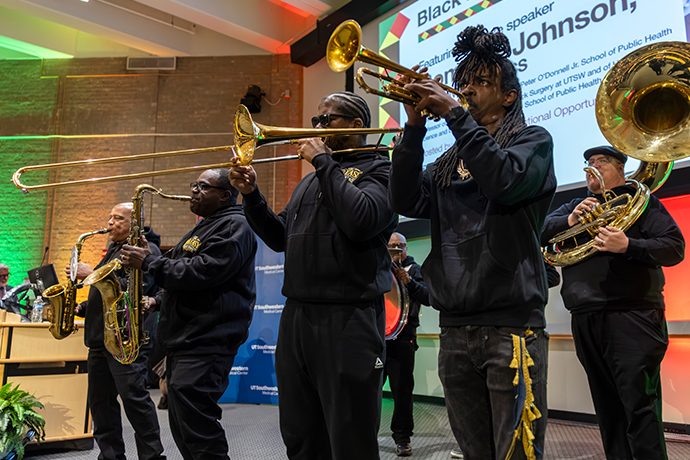
The event opened with a lively musical performance from The Big Easy Brass Band. Rooted in West African traditions, brass bands emerged in the 1800s, when enslaved Africans gathered in Tremé, New Orleans – the oldest African American neighborhood in the United States – to dance, drum, and preserve cultural practices, an enduring tradition the band remains dedicated to today.
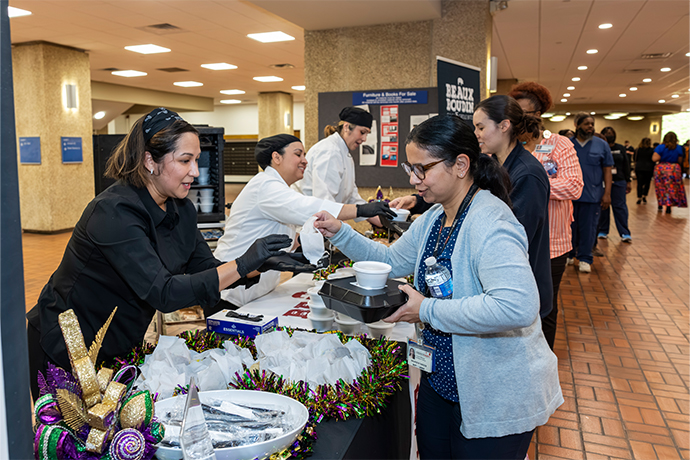
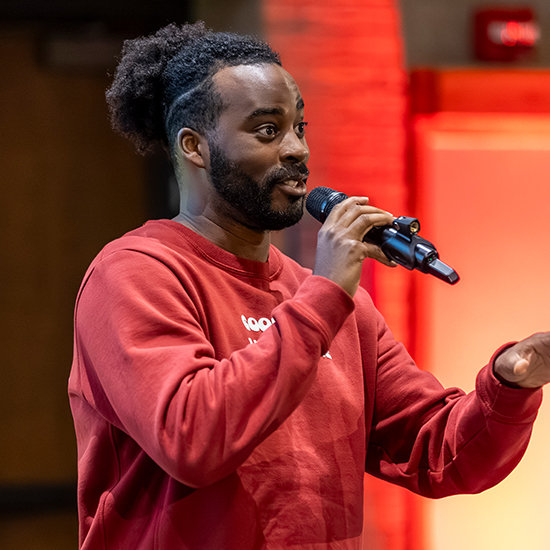
Hosted by the Office for Institutional Opportunity, the Black History Month program also featured a performance by Ryan The Son, a spoken word poet, and a lunch reception of delicacies from Beaux Boudin, a local Black-owned restaurant.
Endowed Title
Dr. Johnson holds the Beth and Marvin C. “Cub” Culbertson Professorship in Pediatric Otolaryngology.