


Meet Warren D’Souza, UTSW’s first Chief Artificial Intelligence Officer

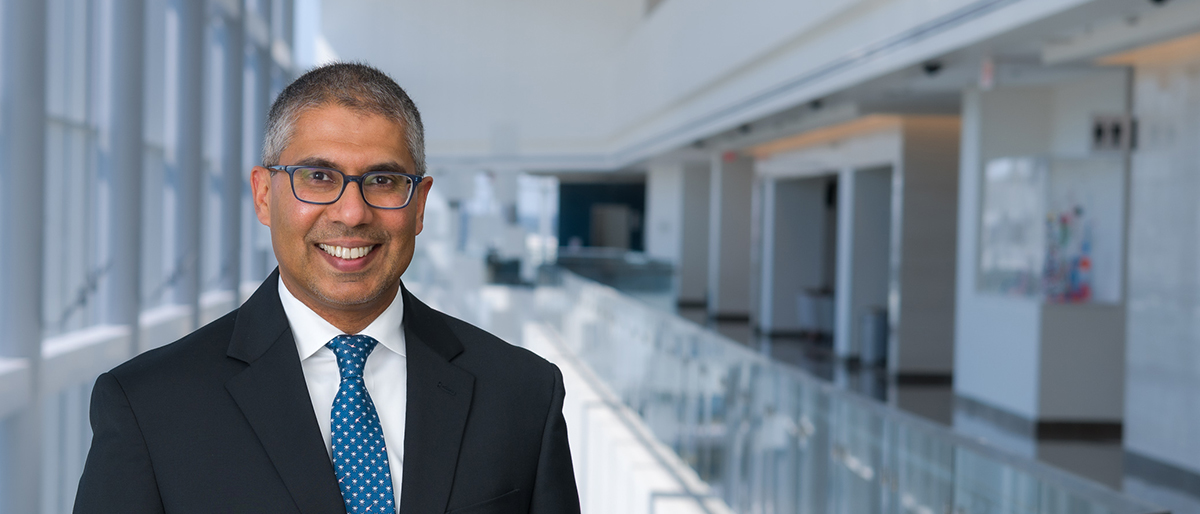
Warren D’Souza, Ph.D., M.B.A., a nationally recognized leader in artificial intelligence (AI), data science, and digital transformation, joined UT Southwestern in early July as its first Chief Artificial Intelligence Officer. He arrives with a clear ambition: to help establish UTSW as a national leader for the responsible, mission-driven use of AI in academic medicine.
“My hope is that UT Southwestern will become a national model for how an academic medical center can use AI responsibly – not as a standalone technology initiative but deeply embedded as a mission-driven capability that advances excellence, innovation, and trust,” he said.
Prior to joining UT Southwestern, Dr. D’Souza served as Senior Vice President and Chief Innovation Officer at the University of Maryland Medical System and co-Director of the University of Maryland Institute for Health Computing. There, he also founded and led a center dedicated to digital health and AI innovation and incubation and oversaw the integration of AI-enabled tools into clinical and operational workflows to deliver measurable impact.
Dr. D’Souza earned a Ph.D. in medical physics from the University of Wisconsin – Madison and an M.B.A. from Duke University. He has written over 100 peer-reviewed articles and holds multiple patents related to novel computational approaches in the delivery of radiation therapy.
Center Times Plus asked Dr. D’Souza about his vision for the future of AI at UT Southwestern and how it will impact the institution’s mission to educate, discover, and heal.
What guided you to a career focused on AI, data science, and digital transformation?
As long as I can remember, I have been attracted to the wonders of science and technology. That passion led me to be curious about their incredible impact on humans.
Early in my career as a medical physicist, I saw how data, computation approaches, and complex modeling could directly improve patient care and clinical decision-making. Over time, that interest expanded from individual tools and models to broader questions of how digital transformation can help healthcare organizations harness these technologies to become more precise, efficient, and learning-oriented. What attracted me most was the opportunity to translate complex technology into practical solutions that could help patients, clinicians, researchers, educators, and technical and administrative teams.
Did you ever imagine artificial intelligence would become the force it is today?
I knew AI had extraordinary potential, but I do not think many of us fully anticipated how quickly it would become transformative. For many years, AI felt like a specialized field used primarily by researchers, engineers, and technical experts. What has changed dramatically is the accessibility of generative AI models, which has brought these tools into the hands of students, clinicians, scientists, administrators, and the public. Generative AI models are advanced algorithms that can create new content such as text, images, music, or videos by learning patterns from existing data.
The pace of adoption has been remarkable, and in many ways, we are still learning how best to use these technologies safely, effectively, and ethically. What is exciting is that AI is no longer an abstract future concept; it is now powerful technology that can help solve real-world problems, guided by human judgment and institutional values.
What are the biggest hurdles you see as AI continues to grow?
The greatest challenges are ensuring that AI is deployed responsibly, safely, and equitably while still allowing innovation to flourish.
In healthcare, the stakes are especially high because decisions can affect clinical decision-making, patient outcomes, trust, and privacy. We also need to help people understand what AI can and cannot do so that it is used appropriately with human-in-the-loop oversight. In the case of completely autonomous AI systems, we need to ensure that these systems are rigorously tested and evaluated prior to deployment and monitored following activation to ensure safety and efficacy and to prevent adverse outcomes.
I believe the institutions that succeed will be those that pair technical excellence with strong governance, transparency, evaluation, and a deep commitment to their mission.
What are some interesting ways AI is already being used in healthcare?
Some of the most fascinating uses of AI in healthcare are those that help clinicians detect patterns earlier, make better decisions, and reduce bumps in daily work, enabling one to work faster and with less effort. AI is already being used to interpret medical images (e.g., CT and MRI), identify patients at risk for deterioration due to their health issues, support earlier disease diagnosis, evaluate biomedical learner/trainee competency, and optimize administrative functions. In research, AI is being harnessed to analyze large multimodal datasets, accelerate therapeutic discoveries, generate hypotheses, and uncover relationships that would be difficult to detect manually. The most promising applications are not simply automation; they augment human expertise and help teams act with greater speed, precision, and insight.
How do you think AI will help advance UTSW into the future?
In clinical care, AI can help support earlier detection, more personalized treatment, safer workflows, and better patient outcomes. In research, it can accelerate discovery by connecting data, prospective therapeutics, and expertise across disciplines in new ways. In education, AI can transform the way we teach, train, and prepare the next generation of clinicians, scientists, and health leaders to work effectively in a technology-enabled world. In administrative functions, AI can help to automate, improving productivity, efficiency, and accuracy.
AI has the potential to strengthen all aspects of UT Southwestern’s mission-driven work. It is a powerful domain that represents significant opportunities to augment and extend human expertise when thoughtfully designed and responsibly implemented and adopted.