


DeMartino appointed Professor Emeritus of Physiology

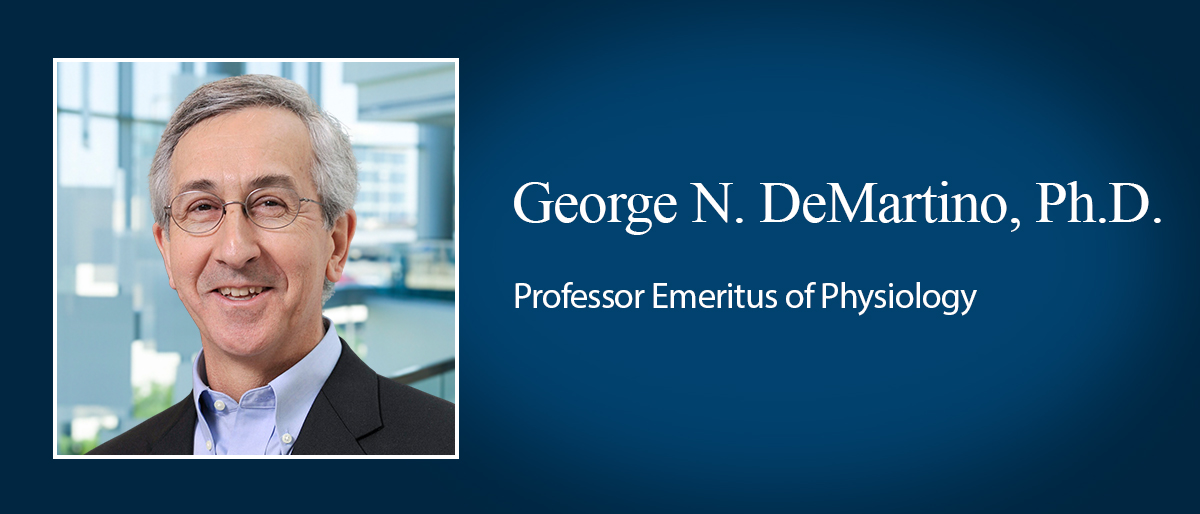
From the start of his career, George N. DeMartino, Ph.D., was driven to understand the process of intracellular protein degradation. This led him to discover the proteasome, an enzyme responsible for the degradation of most cellular proteins.
As a basic scientist for more than four decades, he knows how slowly research can move from bench to bedside. At no time, however, did he expect to see his own work lead to the development of cancer drugs.
“I never thought it would happen in my lifetime; I thought it would be my students or their students who would see that,” said Dr. DeMartino, Professor Emeritus of Physiology. “But it turns out, your findings can go from the lab to becoming a drug during your career.”
The experience has been among the most gratifying for Dr. DeMartino, who has been named Professor Emeritus of Physiology in honor of his outstanding longtime service at UT Southwestern.
“We do what we do as basic scientists, but there it is a great satisfaction to see it can lead to saving people’s lives,” he said.
Since he joined UTSW in 1979, Dr. DeMartino has studied how proteins are broken down in cells by a unique ubiquitin-proteasome system. The process of intracellular protein deterioration regulates most basic cell functions by controlling the amounts of critical proteins and becomes dysregulated in many human diseases. This cycle can be disrupted in many human diseases – sometimes by too much protein breakdown, other times by not enough, he explained.
“We have studied both the biochemistry and physiology of the proteasome to understand molecular details of how it functions as an enzyme and how this function is regulated in cells,” Dr. DeMartino said. “Drugs that block the action of the proteasome are now used clinically to treat a variety of human diseases, such as blood cancers, and are in clinical trials for many others.”
In addition, too much protein destruction can result in muscle atrophy associated with many diseases and conditions, whereas too little can build up toxic proteins that are hallmarks of neurodegenerative diseases such as Alzheimer’s and Parkinson’s.
The proteasome always intrigued him.
“It’s a biochemist’s dream because it is so complicated and just so fascinating,” he said.
Dr. DeMartino’s research provided fundamental insights into how proteasomes work, which led to a drug to treat multiple myeloma. Proteasome inhibitor drugs treat this cancer by blocking the function of proteasomes; this blockage causes proteins to accumulate, killing multiple myeloma cells.
In 2003, a biotech company developed a drug based on proteasome inhibitors for the treatment of relapsed multiple myeloma. It was so effective that it was approved after a phase two clinical trial. Bortezomib became the first proteasome inhibitor approved by the FDA for this cancer.
“That was incredibly gratifying,” Dr. DeMartino said. “Multiple myeloma used to be a death sentence, but now patients can be managed for many years.”
Dr. DeMartino, a Distinguished Teaching Professor, said his interest in science began early. In college, he was torn between pursuing research and medicine.
“I fell in love with the lab,” he said. “From then on, it was science for me.”
After graduating from Union College in Schenectady, New York, with a degree in chemistry, he completed a Ph.D. in biochemistry from the University of Rochester School of Medicine. His graduate work involving the discovery and characterization of new lysosomal proteases began a careerlong interest in intracellular protein turnover.
Following postdoctoral training at Harvard Medical School, Dr. DeMartino joined UT Southwestern as an Assistant Professor. In his lab, he has studied the many molecular and cellular aspects of intracellular protein breakdown.
Over the years, Dr. DeMartino has made seminal contributions to the composition, molecular mechanisms, and biologic roles of the proteasome in health and disease, said Duojia Pan, Ph.D., Chair of Physiology.
“He is an outstanding teacher with an extensive record of service at the local, national, and international levels,” Dr. Pan said.
As Professor Emeritus, Dr. DeMartino has not slowed down. He continues to teach, publish research work, and collaborate with other investigators.
“It’s too exciting a time to leave,” he said. “I’m still super excited about science.”
Endowed Title
Dr. Pan holds the Fouad A. and Val Imm Bashour Distinguished Chair in Physiology.