


How’s your fuel gauge?
Question provides effective tool to monitor medical resident well-being

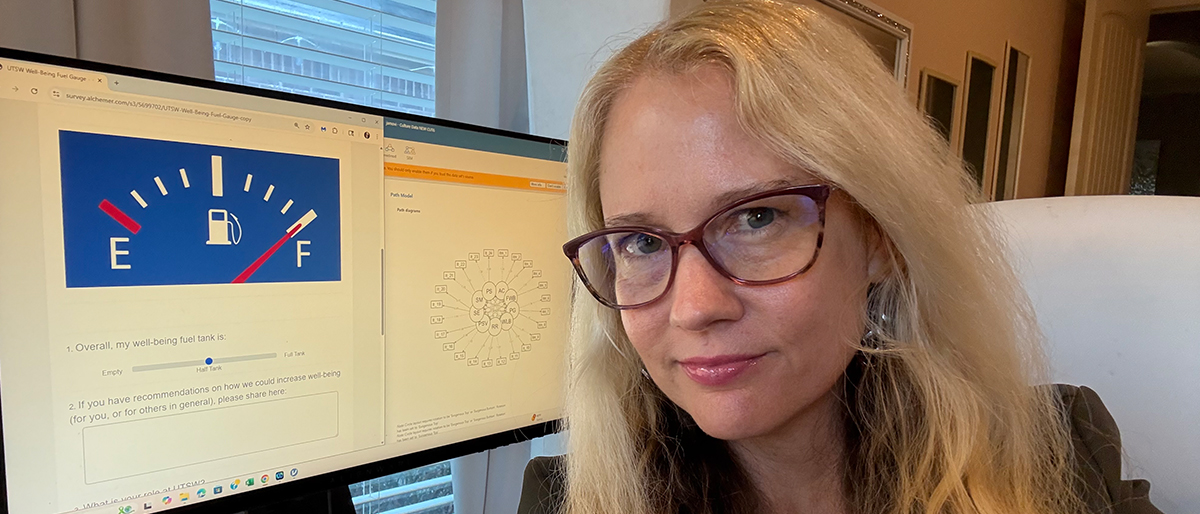
With a simple weekly question, UT Southwestern is leading the way in monitoring and maintaining the well-being of medical residents.
Answers to “How’s your fuel gauge?” provide a snapshot that can detect stress, burnout, or frustration. The gauge has so far generated over 70,000 responses from residents in the Department of Internal Medicine and at least 13,000 comments from those in other departments.
“It’s a quick-and-easy tool that removes that stigma of appearing weak,” said Shannon Scielzo, Ph.D., M.S., Associate Professor of Internal Medicine and creator of the gauge.
Dr. Scielzo formerly served on the faculty of UT Arlington as an industrial and organizational psychologist, specializing in assessment and evaluation. She mentored a wide array of trainees – from psychology, engineering, and business. These students frequently shared different challenges they were facing, and she grew accustomed to them confidently voicing their concerns.
However, when she joined UT Southwestern’s Department of Internal Medicine in 2015 as an Associate Director of Education, she discovered that medical residents frequently tended to be more reserved.“There was this notion that to be a successful trainee, you have to be happy at all times,” she said.
Devising an effective tool
Dr. Scielzo began looking for assessment tools – but found existing ones cumbersome and/or expensive. She wanted a quick diagnostic tool that could be used frequently and would be appropriate for medical trainees.
So, with grants from the Alliance for Academic Internal Medicine and the UT Southwestern Academy of Teachers (SWAT), Dr. Scielzo began creating her own assessment tools. Initially, they proved ineffective.
“We had these great questions, and I’d get 200 answers back, and everyone’s ‘I’m great, I’m fine, top of the charts,’ and I thought oh, come on!” Dr. Scielzo said.“One resident said, ‘I wish we just had a little dashboard on our head so you could see how we’re doing, because we’re not going to tell you.’ So I thought, maybe we’re being too serious.”
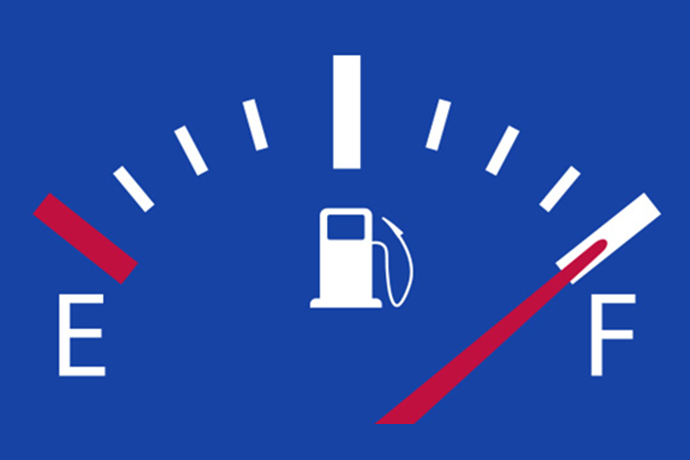
The light bulb went off – and well-being was reframed. The negative stigma that has inherently been tied to individual resilience precluded trainees from opening up.
“Remove the stigma: Don’t ask people if they are depressed or upset. Ask if they need some replenishing,” she said. “This switches the burden to the context – and suggests that individuals have a responsibility to oversee their own ‘tanks.’ You wouldn’t purposefully let your car run out of gas – don’t let yourself run out either.”
And from that came the Well-Being Fuel Gauge, which appears on MedHub, an online management system residents log on to weekly.
“A simple question that went unasked was ‘How do you feel?’” said David Johnson, M.D., Professor of Internal Medicine, who was Chair of the Department during the gauge’s development. “They came up with a novel way of asking that question – it’s very nonthreatening.”
Effectiveness and feedback
The quick test asks two questions of residents each week: 1) Overall, my well-being fuel tank is: (with five bubble fill-in choices) and 2) If you have recommendations on how we could increase well-being, please share here (write-in optional question).
One appeal of the gauge, Dr Scielzo suspects, is that people can report information without explicitly asking for help. And because the document does not require compiling or analyzing data as a questionnaire would, it allows rapid action and feedback from the residency directors.
When low scores are submitted (scores of 1 or 2), program leadership should reach out and check in, she said. Sometimes immediate support may be needed, but oftentimes one low score may just reflect a bad day. If someone doesn’t improve from one week to the next, Dr. Scielzo said options should be offered. This could be as simple as giving the resident a day off.
“Sleep helps greatly,” she said, “and we always strongly encourage trainees to visit the Resident Wellness and Counseling Center (RWAC). They have a broad range of resources available to help our trainees not only refuel, but to excel.”
The assessment is completely voluntary. Nonanswers aren’t a cause for concern, she added, since research on the tool suggests those who don’t enter a score are usually doing as well or better than their peers.
Learnings from the tool
Leaders of UTSW programs can use the data from the fuel gauge tool to drive change.
“We have learned that certain rotations, and certain conditions, are much more likely to tank scores. People working together tend to report similar scores, so this provides a lot of support for the impact of the environment on well-being,” Dr. Scielzo said. “When we identify issues, it empowers us to fix them.”
Furthermore, program leadership can use this data to create some transparency with trainees, responding to their concerns and letting them know how they are being addressed.

The success of the tool has led to its use by more than half of UTSW’s resident and fellow programs at some point, and a similar version was used by UT Southwestern faculty and staff during the COVID-19 pandemic. Dr. Scielzo said other schools also have begun using fuel gauges, sometimes with adaptations. Duke University, for example, sends out a similar test via text.
She and her colleagues have already published several studies documenting the tool’s effectiveness, including in the Journal of Surgical Education, the Journal of Graduate Medical Education, and the Journal of the American College of Surgeons.
“We now have an immense amount of data, and we would like to better understand some of the trends. For example, we would like to see to what extent programs systematically vary over time, and whether fuel levels correspond to other indicators (such as periods where we know trainees struggle, and performance outcomes),” she said. “Furthermore, we would like to better understand the qualitative data and see what else we can learn from the incredible comments we have received over the years.
“We really want to continue to drive change – and continue to find ways to optimize well-being for our trainees.”
Endowed Title
Dr. Johnson holds the R. Ellwood Jones, M.D. Distinguished Professorship in Clinical Education.