


A researcher's Valhalla: UT Southwestern grad student attends Nobel Laureate gathering in Germany

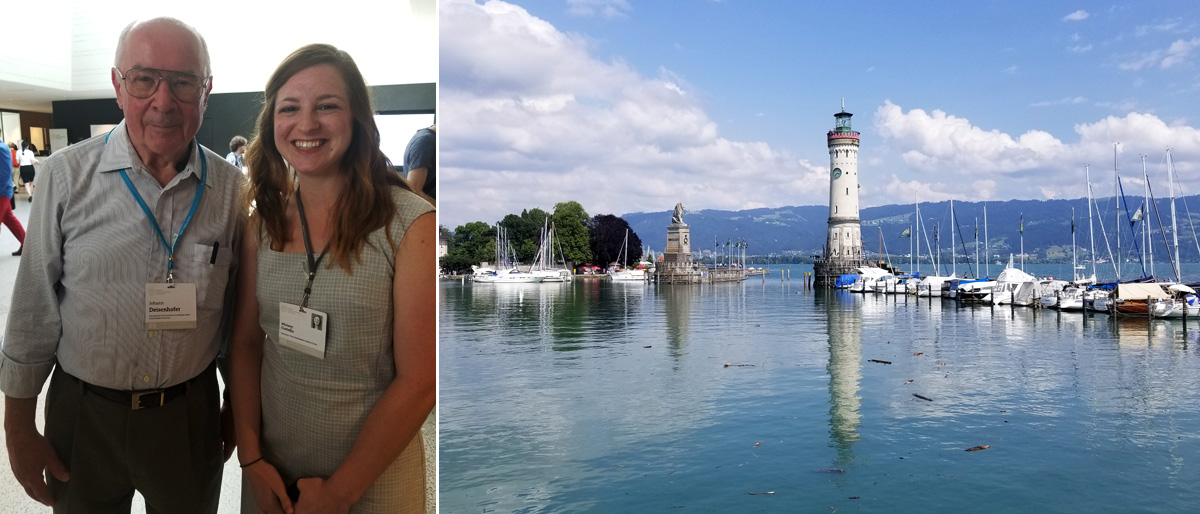
Whitney Costello’s life reads a bit like Oh, the Places You’ll Go! by Dr. Seuss.
The UT Southwestern graduate student researcher grew up in Norman, Oklahoma, and started out thinking she would become a meteorologist before veering into molecular biophysics instead.
That change in direction has led her to study in Italy, to work as a researcher in China, and most recently to participate as one of about 600 promising students from around the world in the rarefied air of the Lindau Nobel Laureate Meetings, held each year in Germany. The event took place the first week of July on the picturesque island of Lindau in Lake Constance, near Germany’s southern border with Austria and Switzerland, with the Alps as a backdrop.
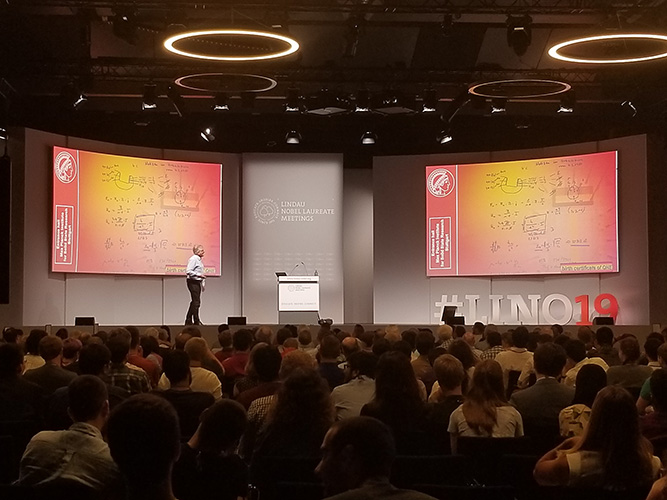
Ms. Costello wasn’t the only member of the UT Southwestern community in attendance. Dr. Johann Deisenhofer, UTSW Professor Emeritus of Biophysics and in the Cecil H. and Ida Green Comprehensive Center for Molecular, Computational, and Systems Biology, was among nearly 40 Nobel Laureates speaking at the event. Dr. Deisenhofer, who shared the 1988 Nobel Prize in Chemistry, gave a talk about photosynthesis, the topic that won him his prize after he uncovered the structure of the reaction center involved in that natural process.
The Lindau Meetings began in 1951 as a way to bring together college undergraduates, Ph.D. students, and postdoctoral researchers to meet and attend lectures and panel discussions by Nobel Laureates. The event is designed to foster dialogue between Nobel Laureates and young scientists.
It’s a great opportunity to network with scientists all over the world,
Ms. Costello said. You never know what collaborations will come. And it’s not every day that you get to be in a room with 30 people and a Nobel Laureate. It’s a truly amazing experience.
Whitney is training on the cutting edge of a new and exciting field and technique that sits squarely at the interface of physics, physical chemistry, and biology, and she has the scholarly attitude, intellectual talent, and personal determination to make a mark,
said Dr. Luke Rice, Associate Professor of Biophysics and Biochemistry and Chair of the Molecular Biophysics Graduate Program, who sent Ms. Costello’s nomination to Lindau. Whitney is also admirably engaged as an advocate for women in science. We are so proud that she was selected to attend the Lindau Meetings.
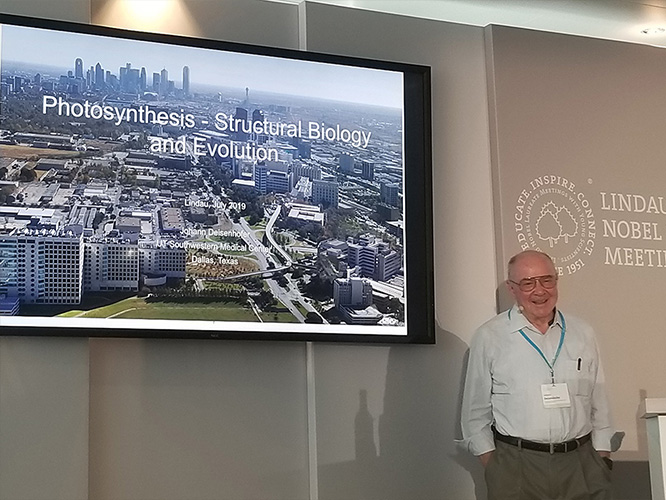
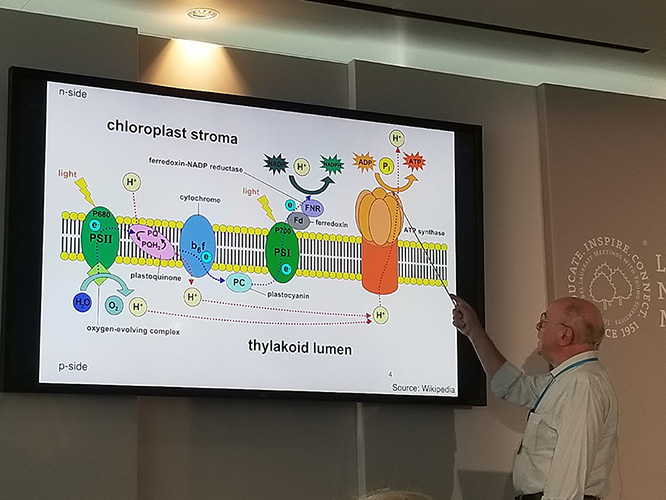
During her six days at Lindau, Ms. Costello attended many lectures, including Dr. Deisenhofer’s talk and one by Dr. Steven Chu, co-recipient of the 1997 Nobel Prize in Physics for work in laser cooling and atom trapping.
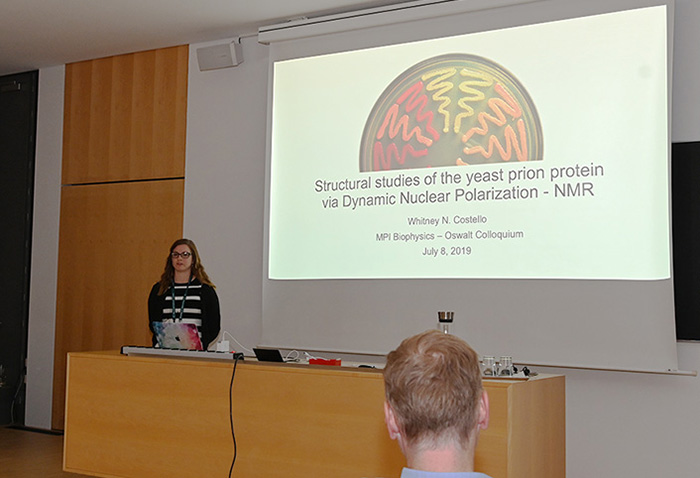
She also was chosen to speak about her own research at the prestigious Max Planck Institute of Biophysics in Frankfurt.
But, for her, the highlight was the lunch she sat down to at an Italian restaurant with just a handful of students and Nobel Laureate Dr. Ada E. Yonath. Dr. Yonath, who grew up in Israel, won the Nobel Prize in Chemistry in 2009 for her studies of the structure and function of the ribosome – studies made possible after she cracked the code on how to create the first ribosome microcrystals and later published a three-dimensional structure of the elusive cell particle that builds life’s proteins.
She’s a very great biophysicist. People told her she’d never solve the structure of the ribosome, and she did it,
Ms. Costello said. It’s really nice to see her passion for the ribosome after all these years. She still really loves it.
For Ms. Costello, who serves as the graduate student representative on UT Southwestern’s Women in Science and Medicine Advisory Committee, it was reassuring to hear Dr. Yonath talk about her family, including a granddaughter who invited the respected scientist to speak to a kindergarten class about the ribosome.
Ms. Costello was always good in math and science but felt too much of an introvert to ever become a doctor.
An inspiring high school physics teacher and a stint working on a college research project led her to switch her major from meteorology to physics as an undergraduate at the University of Oklahoma. (It’s very difficult to predict weather patterns,
she added.)
Watching her grandmother and grandfather die while she was in college – both from neurological diseases – is what drove her to focus on biophysics, a field that uses the math of physics to describe and understand biology, she said. I felt no one should have to suffer like that,
she said of her grandparents.
In her current research, Ms. Costello studies amyloid proteins in the cellular context. Amyloid protein aggregates are associated with Alzheimer’s, the disease that killed her grandmother. She is looking at how yeast organize amyloid prion proteins without creating the problem of the huge, unorganized aggregates sometimes seen in humans that may lead to cell death.
Does Ms. Costello plan to return to Lindau soon?
No. No. If you go back, it must be as a Nobel Laureate,
she said. I think some luck is involved with that.
Dr. Deisenhofer is a Regental Professor.
Dr. Rice is a Thomas O. Hicks Scholar in Medical Research.