


Student spotlight: Q&A with Graduate Student Elizabeth Polsdofer

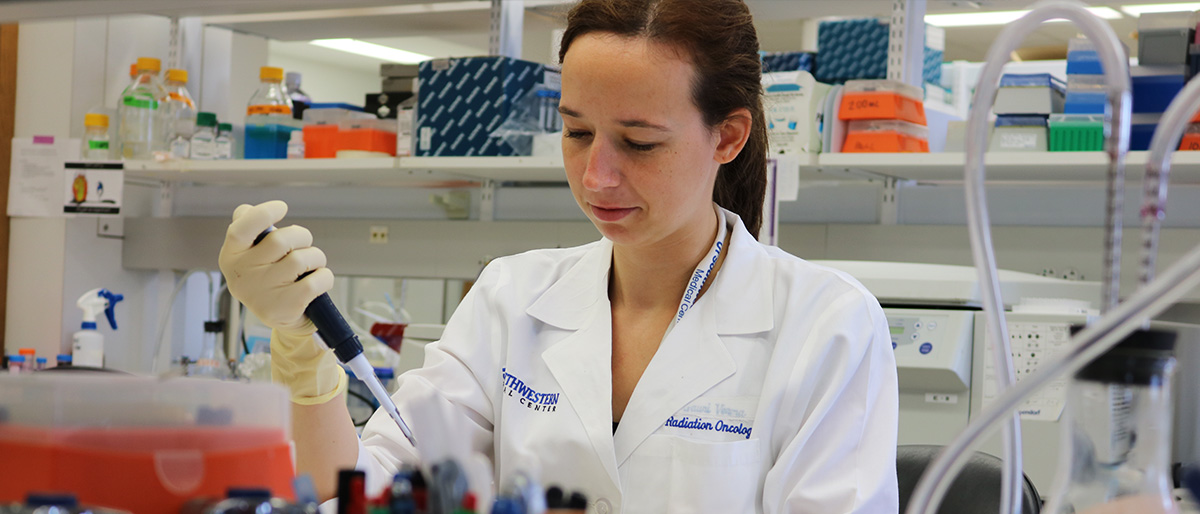
This interview first appeared in The Target, a print publication of the Department of Radiation Oncology, as part of its Women in Research series, which highlights the everyday efforts and successes of women in Radiation Oncology.
*****
As a graduate student in Biomedical Engineering, Medical Physics track, Elizabeth Polsdofer has focused on using artificial intelligence tools to predict radiation therapy outcomes in head and neck cancer.
She currently works in the lab of Dr. Michael Story, Professor of Radiation Oncology in the Division of Molecular Radiation Biology. Ms. Polsdofer earned her Bachelor of Science in physics in 2013 from Iowa State University and her Master of Science in medical physics in 2016 from Oregon State and Oregon Health and Science Universities. We caught up with Ms. Polsdofer to discuss her trajectory in the field of physics and her experience as a woman in research.
Q: What and who inspired you to start a career in physics?
EP: I loved calculus in high school, and once I figured out how it worked, it became natural for me to be good at it. Over time, I realized how I could use it to solve problems. Pursuing a degree in physics wasn’t always easy, though. I often wondered if I had “impostor syndrome” because I felt like I didn’t belong in such a competitive field. Then one of my professors encouraged me to apply for an astronomy internship at the Space Telescope Science Institute in Baltimore. Being accepted into this program as an intern was a true turning point. I studied the infrared variability of objects using data from the Spitzer Space Telescope and published my results as first author in The Astronomical Journal in 2015.
Q: How did you decide to enter the field of medical physics?
EP: My dad was diagnosed with stage IIIB bladder cancer, which he later recovered from. Right before his surgery, I remember looking at a group of doctors having a casual conversation during breakfast in the hospital cafeteria. This was a normal day of hard work for them, and right then, I realized that my dad would be in good hands. This made me wonder if I could use my skills to help people in a similar way and led to the decision to pursue a higher degree in medical physics. It has been a great journey so far, and I am honored to be working in a radiation biology lab as part of my graduate studies. I like how biology focuses on understanding the mechanisms behind processes, which explains why certain radiation treatments work better than others.
Q: What do you feel are your most exciting achievements and discoveries in the field?
EP: I have worked on a project in which we are testing GC4419, an experimental drug that in clinical trials has reduced severe adverse effects of radiation therapy. We studied its role in protecting against lung fibrosis caused by irradiation, with the goal of providing dose escalation to patients whose tumors are near critical normal tissues. These patients might not receive as high irradiation doses because of sensitivity of the surrounding normal tissues. However, if the drug can protect against this damage, then we may get better local control with higher doses. Since the start of the project, a clinical trial has been completed, and GC4419 has been designated by the FDA as a Breakthrough Therapy.
Q: What are you most proud of so far?
EP: I was invited by two former professors to speak at the Conference for Undergraduate Women in Physics (CUWiP) in January 2018 at Iowa State University, the institution where I earned my undergraduate degree in physics. I was part of a session panel titled “Thriving in Physics” along with six other women physicists. We discussed topics such as succeeding in classes, keeping a good work-life balance, and starting a career in research or industry. It was inspiring to share my experience with undergraduate women in physics, and I felt truly honored to be part of this important initiative.
Q: Only a few women begin a career path in physics. Did you experience any difficulties in a scientific environment that is mostly male-dominated?
EP:As a minority in this field, I have sometimes felt uncomfortable with male classmates because they didn’t always relate to me in the same way they did to other men. The reasons are several. I have received unwanted attention and felt like I had to tweak my behavior to be less feminine because of it. Also, I have had to fight the perception by some of being the helpful one only because I am a woman. And as a single woman, I have experienced pressure to be in a relationship by both men and women. In terms of gender equality in the field of physics, we still have much work to do.
Q: What advice do you have for young women wishing to pursue a career in physics?
EP: If you are strongly motivated to pursue this career path, don’t give up because it’s highly rewarding and always exciting. Find good mentors. Dr. Story has been very encouraging, supporting me along the way with his calm demeanor and ability to provide straightforward, easy solutions to different problems. And bond with other women scientists so you can help one another during difficult times.
Dr. Story holds the David A. Pistenmaa, M.D., Ph.D. Distinguished Chair in Radiation Oncology.