


Thinwa honored with Women Who STEAM Award

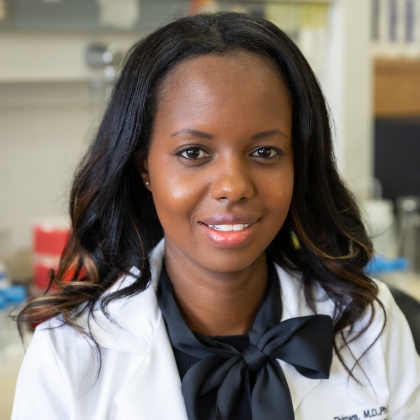
As a physician-scientist, Josephine Thinwa, M.D., Ph.D., is driven by three things: delivering the best possible care to patients, pushing the boundaries of knowledge in the pursuit of new treatments, and training the next generation of physician-scientists. For her leadership in all three areas, Dr. Thinwa was honored with a 2026 Women Who STEAM Award from the Dallas Chapter of The Links.
“I am honored and humbled to join the extraordinary women who inspired me to believe I could be a physician-scientist,” said Dr. Thinwa, an Assistant Professor of Internal Medicine in the Division of Infectious Diseases and Geographic Medicine and of Microbiology. She is also the Associate Program Director of the Internal Medicine Physician Scientist Training Program. “I hope this recognition encourages other young women who may be wondering whether it is worthwhile to pursue a career in science and medicine.”
Follow Your Spark: Josephine Thinwa
Founded in 1946, The Links is an international nonprofit volunteer service organization committed to enriching, sustaining, and ensuring the culture and economic well-being of people of African ancestry. The Dallas Chapter was chartered in 1957. Its signature program, the STEAM Academy, provides equitable access and opportunities for middle and high school girls of color in science, technology, engineering, art, and math – or STEAM. Its annual Women Who STEAM Awards recognize women who exemplify extraordinary contributions in their fields. The 2026 awards were presented at an April 2 luncheon.
Originally from Kenya, Dr. Thinwa earned a bachelor’s degree in biology from Southwestern University in Georgetown, Texas, followed by combined M.D./Ph.D. degrees, with doctoral studies in microbiology, from UT Health Science Center at San Antonio. She completed her residency in internal medicine at UT Southwestern, followed by advanced training in infectious diseases as part of the Physician Scientist Training Program. Her long-held interest in innate immunity and viruses led her to work as a postdoctoral researcher in the lab of Beth Levine, M.D., an international leader in autophagy research and Professor of Internal Medicine and Microbiology at UTSW, who passed away in 2020.
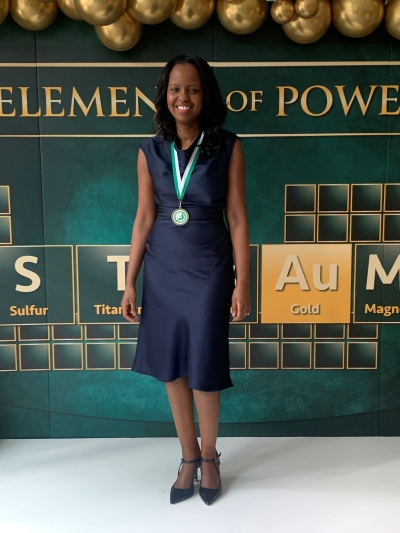
“From Kenya to UT Southwestern, Dr. Thinwa’s journey reflects her unwavering commitment to tackling infectious diseases and advancing global health,” the Dallas Chapter of The Links noted in its award announcement, which also referenced her innovative research and collaboration with Girls Empowered by Mavericks (GEM), a mentorship program sponsored by UTSW and the Dallas Mavericks. “Her passion for both medicine and research is matched only by her dedication to inspiring the next generation of scientists,” the organization said.
Dr. Thinwa’s research is uncovering how our bodies naturally fight viral infections and how those built-in defenses can be enhanced to overcome infection. The Thinwa Lab discovered a protein called CDKL5 (cyclin-dependent kinase-like 5) that acts like a switch, triggering the cell’s internal cleanup system – called autophagy – to destroy invading viruses and strengthen the immune response. Additionally, she is co-leading the development of a nanoparticle that specifically activates this cleanup process, which helps cells survive a viral attack.
Also passionate about mentorship, Dr. Thinwa participates in multiple student outreach programs, including serving on a female empowerment panel at the fourth annual GEM Celebration held at American Airlines Center in 2025.
“I spoke to nearly 900 girls about my journey in science and medicine. I represented UT Southwestern and was the only physician or scientist on the panel,” Dr. Thinwa said.