


Choi receives SUHF Young Investigator Award

It’s the body’s sophisticated somatosensory system that enables us to feel the comfort of a warm hug, the sting from a mosquito bite, and aches in our muscle after an intense workout.
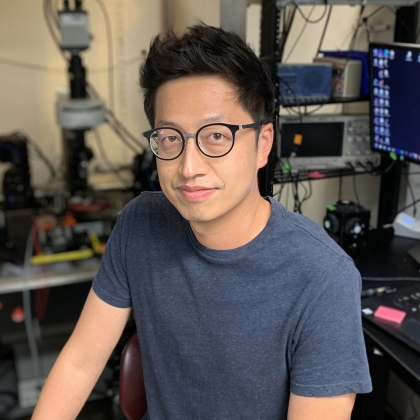
Much is known about how we sense touch, temperature, itch, and pain as adults, but when and how we begin to sense the physical world remains unclear, said Seungwon “Sebastian” Choi, Ph.D., Assistant Professor of Psychiatry, Neuroscience, and Anesthesiology & Pain Management. The Choi Lab is working to determine when functional somatosensory circuits are formed and wired during development, how they mature, and how early sensory experiences shape their function.
“We hope our study will provide fundamental insights into functional circuit assembly in the developing spinal cord and help reveal novel therapeutics for treating neurodevelopmental disorders,” said Dr. Choi, also an Investigator in the Peter O’Donnell Jr. Brain Institute.
In support of this work, Dr. Choi is one of four recipients of a 2026 Suh Kyungbae Foundation (SUHF) Young Investigator Award, which provides about $650,000 (KRW 900 million) over three years, with the potential for additional support for up to nine years. The South Korea-based foundation, which is guided by a philosophy that states “there is an infinite sky beyond the visible one,” has awarded grants to 35 early-stage life scientists since its founding in 2016. Honorees have included investigators from top research institutes in South Korea as well as Korean scientists based in the U.S.
“I am deeply honored to be an award recipient and to join this remarkable community of current and past SUHF fellows,” Dr. Choi said. “I am also grateful for the generous funding that will allow us to tackle the fundamental question: When and how do we start sensing the physical world?”
Ultimately, Dr. Choi hopes to provide insights into new therapeutic targets and strategies for treating sensory conditions, including autism spectrum disorder (ASD).
“Sensory abnormalities and social impairments are the most prevalent symptoms among individuals with neurodevelopmental disorders such as ASD,” he said. “Evidence suggests that early sensory experience can shape the development and maturation of social behaviors.”
Dr. Choi plans to bring conceptual and technical innovations to developmental neuroscience.
“We will use systems neuroscience approaches and techniques such as powerful new genetic tools, sophisticated anatomical tracings, large-scale, high-density in vivo electrophysiology, and novel behavioral paradigms,” he said. “I hope our study will uncover new principles of nervous system development.”
Born in South Korea, Dr. Choi received his B.S. and M.S. from the Korea Advanced Institute of Science and Technology (KAIST). After earning his Ph.D. at Harvard University, he completed a postdoctoral fellowship at Harvard Medical School. He joined the UTSW faculty in 2022.