


The Obesity Society honors Almandoz, Williams for clinical care, research

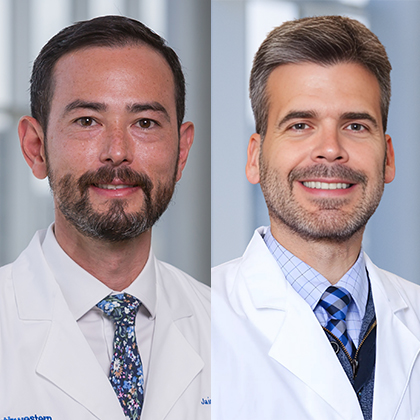
Two UT Southwestern faculty members are being recognized with top awards from The Obesity Society (TOS), the leading professional organization focused on obesity science, treatment, and prevention. Jaime Almandoz, M.D., M.B.A., Professor of Internal Medicine in the Division of Endocrinology, was named Clinician of the Year, and Kevin Williams, Ph.D., Associate Professor of Internal Medicine and a member of the Center for Hypothalamic Research, was selected for the inaugural Xavier Pi-Sunyer Award.
The awards were presented Nov. 4 during ObesityWeek 2025, The Obesity Society’s annual scientific meeting, in Atlanta.
Clinician of the Year Award
Jaime Almandoz, M.D., M.B.A., FTOS
Professor of Internal Medicine
Medical Director, UTSW Weight Wellness Program
For excellence in the practice of obesity medicine, The Obesity Society’s Clinician of the Year Award is given to a physician who has achieved a high level of competency and understanding in obesity care.
“I am deeply honored to receive this recognition,” said Dr. Almandoz, who serves as Medical Director of UT Southwestern’s Weight Wellness Program. “It celebrates the hard work and dedication of the entire Weight Wellness team and our collaborators across UT Southwestern who provide patient-centered, evidence-based care for people living with obesity.”
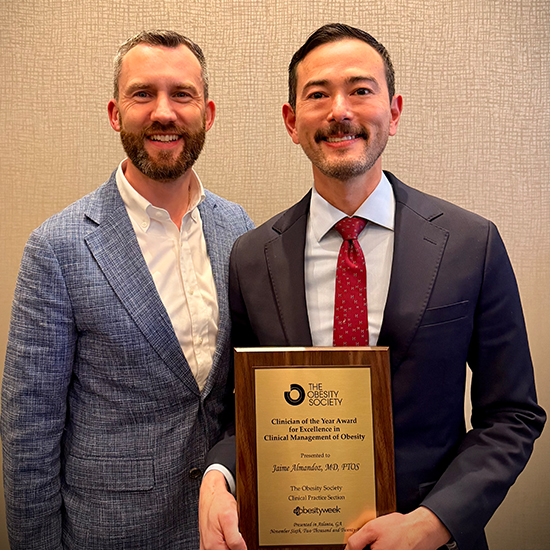
Launched in 2015, the UTSW Weight Wellness Program intertwines innovation and compassion, offering people with excess weight or obesity the most advanced treatments available for weight management.
“Obesity care is not simply about weight loss; it is about meeting patients where they are and providing patient-centered treatment that combines the latest pharmacologic and surgical options on top of a foundation of personalized nutrition, physical activity, and behavioral health support,” Dr. Almandoz said. “When delivered by a multidisciplinary team, effective obesity care can improve health and quality of life in ways that matter to patients beyond the number on the scale.”
Emphasizing longitudinal care, the interdisciplinary group of providers – board-certified obesity specialists, nurse practitioners, physician assistants, registered dietitians, behavioral health clinicians, and other team members – create individualized plans that combine evidence-based pharmacotherapy and bariatric surgery with tailored nutrition, exercise, and psychosocial support.
“Excellence in practice requires thoughtful treatment selection through shared decision-making, close follow-up with measurable clinical endpoints, and rapid management of any adverse effects,” Dr. Almandoz said. “This award recognizes our sustained program development, innovation in care delivery, and commitment to teaching and mentorship, all aimed at improving health and quality of life for our patients.”
Continuing to grow the Weight Wellness Program, Dr. Almandoz and his team are deepening collaborations with basic science, translational, and public health colleagues to translate mechanistic insights into more effective therapies for the diverse populations they serve, he said. They are also working to develop scalable, equitable models of obesity care that can be adopted across health systems.
Originally from Trinidad, Dr. Almandoz received his medical degree from the Royal College of Surgeons in Ireland. He completed internal medicine residency and fellowship training in endocrinology at the Mayo Clinic, and an additional fellowship program in nutrition and metabolic diseases at UTSW. He joined the UT Southwestern faculty in 2013.
A nationally recognized leader in obesity medicine, Dr. Almandoz serves on the boards of directors for the American Board of Obesity Medicine and ObesityWeek LLC and is the incoming Chair of the Nutrition and Obesity Disease State Network for the American Association of Clinical Endocrinology (AACE). He is also a Fellow of The Obesity Society (FTOS).
“I’m deeply grateful to my colleagues, trainees, and patients for their partnership. I remain committed to training the next generation, expanding access to multidisciplinary obesity care, and doing research that improves health for our diverse community,” he added.
Xavier Pi-Sunyer Award
Kevin Williams, Ph.D.
Associate Professor of Internal Medicine
The Xavier Pi-Sunyer Award recognizes a midcareer investigator who is making an innovative and impactful contribution to obesity research, treatment, or clinical care.
“Dr. Pi-Sunyer was a pioneer in the field of obesity research and clinical care, and to receive the first award given in his name is a tremendous privilege,” Dr. Williams said.
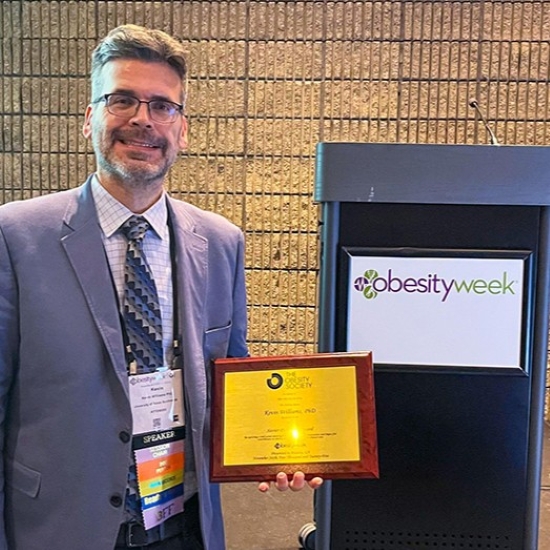
The Williams Lab studies how the brain regulates body weight, blood sugar levels, and metabolism.
“We spend a lot of time studying neurons and brain circuits that regulate food intake, body weight, and blood glucose control. At times this level of basic science can feel quite far removed from the clinic,” he said. “Having The Obesity Society recognize this type of fundamental neuroscience as critical to obesity research underscores how important basic discovery is to developing future therapies.”
The lab’s research has helped explain how therapies for obesity and diabetes work in the brain. For example, Dr. Williams and his team identified specific populations of neurons that respond to hormones like leptin and commonly used treatments such as topiramate, serotonin 2C receptor agonists, and GLP-1 receptor agonists. The investigators also have shown that the same brain circuits respond to nutrient state and lifestyle interventions like exercise.
“By pinpointing the neurons that serve as ‘control points’ for appetite, body weight, and glucose regulation, our research has revealed new insights into why existing therapies are effective and has opened the door to designing the next generation of treatments,” he said.
Beyond the lab, Dr. Williams co-hosts DiabetesBio, a podcast produced with the American Diabetes Association’s flagship journal – Diabetes. On the show, he has spoken with leading researchers and clinicians as well as patients and family members who have personal experiences with diabetes and obesity.
“For me, the podcast is important because it bridges the gap between the lab/clinic and the public. It celebrates the people behind the discoveries, makes complex science more accessible, and shows why this work matters beyond academic journals,” he said.
After earning a bachelor’s degree in biology from UT Dallas, Dr. Williams completed his doctorate in neuroscience at Tulane University in Louisiana, followed by postdoctoral fellowship training in hypothalamic research at UT Southwestern. He joined the UTSW faculty in 2009.
“What drew me here and has kept me here is the remarkable environment for collaboration, particularly in metabolism and neuroscience,” he said. “UT Southwestern has an extraordinary community of researchers who are leaders in their fields, but who are also generous colleagues willing to share ideas and resources. That combination creates an environment where ambitious questions can be asked and answered. It has been the ideal place to build my research program and to mentor the next generation of scientists.”