


Pomper shares American Innovator Award from Bayh-Dole Coalition


In 1996, Martin Pomper, M.D., Ph.D., came across two intriguing publications. One described inhibitors of a brain enzyme called NAALADase, which produces glutamate, a neurotransmitter critical for brain function, learning, and memory. The other explained that NAALADase is the same protein as the prostate-specific membrane antigen (PSMA) that is overexpressed in prostate cancer. It was a watershed moment for the physician-scientist.
“By putting them together, I pivoted from developing imaging agents for brain NAALADase for mapping glutamatergic neurotransmission to developing imaging and radiotherapeutic agents for PSMA and management of prostate cancer,” said Dr. Pomper, Chair and Professor of Radiology.
The change in focus led to the discovery of PYLARIFY, developed in collaboration with former colleague Robert Dannals, Ph.D., Professor of Radiology and Radiological Science at Johns Hopkins University School of Medicine. Administered via injection, the fluorinated small molecule imaging agent attaches to cells with elevated PSMA levels, making prostate cancer cells highly visible on positron-emission tomography (PET) scans – enabling doctors to pinpoint cancer sites without a biopsy.
For this work, Drs. Pomper and Dannals are among eight recipients, representing five invention stories, to receive 2026 American Innovator Awards from the Bayh-Dole Coalition. Recipients were honored in early June at the Faces of American Innovation event in Washington, D.C., where they had an opportunity to participate in a Capitol Hill briefing for congressional members and attend meetings with congressional offices to advocate for American innovation.
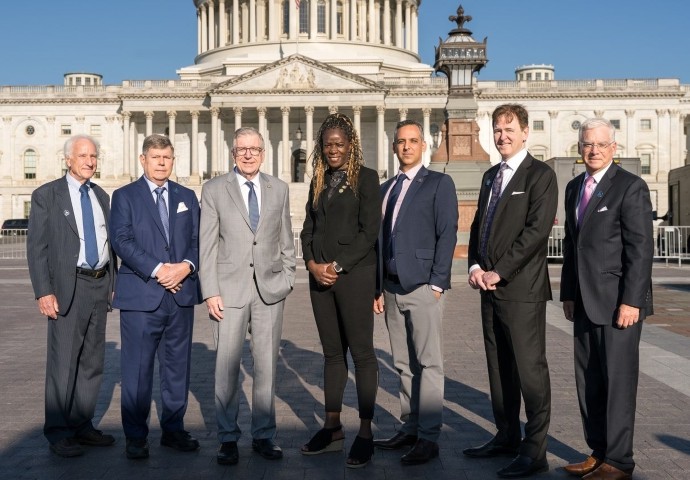
“Dr. Pomper’s breakthrough gave physicians the ability to see prostate cancer with a level of clarity and accuracy that simply wasn’t possible before,” said Joseph P. Allen, Executive Director of the Bayh-Dole Coalition. “The Bayh-Dole Act enabled him to take that discovery out of the lab, attract private investment, and deliver it to patients – where it’s now transforming care and driving a rapidly growing field of medicine.”
Since its approval by the Food and Drug Administration in 2021, PYLARIFY has been used in over 760,000 scans. Recently the FDA approved PYLARIFY TruVu, a new formulation that supports more efficient manufacturing and distribution, paving the way for greater accessibility for patients.
Dr. Pomper’s group also developed a chemical scaffold (molecules that bind to cancer cells) with a metal chelator (a chemical structure that brings a radioactive metal directly to cancer cells for imaging or therapy).
These advances have in part revitalized the field of nuclear medicine and specifically molecular radiotherapy, also known as theranostics.
“PSMA-targeted PET is now used to manage prostate cancer, largely replacing other imaging modalities such as bone scans and computed tomography,” Dr. Pomper said. “Radiotherapeutics based on our initially reported agents are now also used worldwide and are being optimized by us and others for treatment. After investment by Novartis, other large pharmaceutical companies, and venture capital, theranostics have taken off, with many molecular targets beyond PSMA being pursued for imaging and treating a wide variety of cancers.”
Passed in 1980, the Bayh-Dole Act changed patent and trademark regulations to allow universities, nonprofits, and small businesses to retain ownership of inventions made during federally funded research. The Bayh-Dole Coalition is a group of innovation-oriented organizations and individuals committed to celebrating and protecting the Bayh-Dole Act as well as informing policymakers and the public of its many benefits. Its 300-plus members span the innovation life cycle, from research institutions and university tech transfer offices to venture capital advocates, small-business groups, and more.
“I am immensely grateful to the Bayh-Dole Coalition for this award, which I share with my colleagues and trainees who enabled the work that led to this. I thank my institutions, UT Southwestern Medical Center and Johns Hopkins Medical School, for providing the unique environments in which transdisciplinary, mission-driven research thrives to benefit our patients and community,” Dr. Pomper said.
“Without the Bayh-Dole Act, we would not have sophisticated tech transfer offices at academic centers around the country today,” he added. “Because inventors and their institutions can now benefit financially from government – National Institutes of Health – sponsored research support due to Bayh-Dole, they can reinvest back into research and development in a virtuous cycle of innovation.”
Dr. Pomper’s research on molecular imaging and therapy for cancer and central nervous system disorders has resulted in over 500 peer-reviewed publications in scientific journals, numerous patents, and invitations to present at professional conferences throughout the world. After receiving his Ph.D. and M.D. from the University of Illinois, he completed postgraduate medical training at Johns Hopkins, including a medical internship, residencies in diagnostic radiology and nuclear medicine, and a fellowship in neuroradiology. After 28 years on the faculty at Johns Hopkins Medicine, he joined UT Southwestern in 2023.
In addition, Dr. Pomper received the Benedict Cassen Prize during the 2026 Society of Nuclear Medicine and Molecular Imaging Annual Meeting in Los Angeles. Presented every other year by the Education and Research Foundation for Nuclear Medicine and Molecular Imaging, the award recognizes outstanding achievement and work leading to a major advance in nuclear medicine science.