

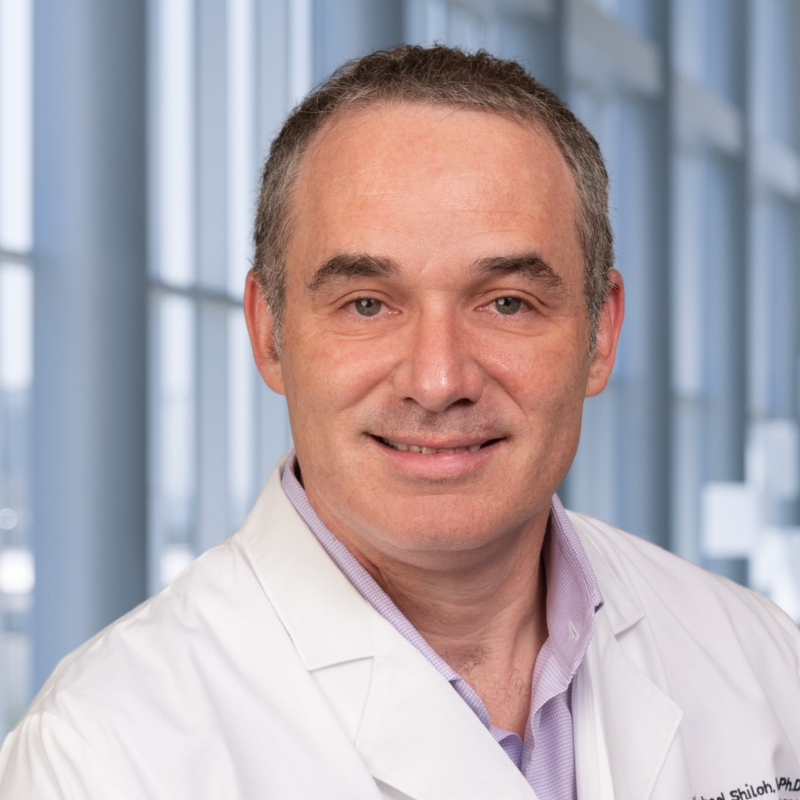
Michael Shiloh, M.D., Ph.D.
Associate Professor
Endowed Title James P. Luby, M.D. Professorship in Infectious Diseases
School Medical School
Department Internal Medicine | Microbiology
Graduate Programs Immunology, Molecular Microbiology
You have reached the Academic Profile.
For more information on the doctor and patient care, please visit the clinical profile.
View Clinical Profile
Biography
Michael Shiloh, M.D., Ph.D., is an Associate Professor with tenure in the Departments of Internal Medicine and Microbiology at UT Southwestern Medical Center and a member of the Division of Infectious Diseases and Geographic Medicine. He holds the James P. Luby, M.D. Professorship in Infectious Diseases.
Dr. Shiloh earned a bachelor's degree with honors in chemistry from Pennsylvania State University in State College. He received his medical degree and his doctorate in immunology at Cornell University in New York. He then completed internal medicine residency training, a fellowship in infectious diseases, and a molecular medicine fellowship at the University of California San Francisco.
Certified by the American Board of Internal Medicine in internal medicine and in infectious diseases, Dr. Shiloh joined the UT Southwestern faculty in 2011 as an Assistant Professor. He was promoted to Associate Professor with tenure in 2018.
At UT Southwestern, Dr. Shiloh is a member of the Biosafety Committee and the Medical Scientist Training Program Steering Committee. He's also a member of several professional societies, including the Infectious Disease Society of America, the American Society of Microbiology, the American Association of Immunologists, and the American Society of Clinical Investigation.
Dr. Shiloh's research interests include tuberculosis, immunology, and microbiology. In his laboratory, his long-term research goal is to discover the mechanisms by which Mycobacterium tuberculosis (Mtb) causes disease in humans. His findings have resulted in numerous peer-reviewed publications, invited lectures, reviews, and book chapters.
Personal Note
Outside of work, Dr. Shiloh enjoys hiking, running, playing soccer, traveling, and cooking.
Education
- Medical School
- Cornell University Medical College (2001)
- Residency
- University of California, San Francisco (2003), Internal Medicine
- Fellowship
- University of California at San Francisco (2007), Infectious Diseases
Research Interest
- Autophagy
- Innate Immune Response to Intracellular Pathogens
- Microbial Pathogenesis
- Mucosal Immunology
- Mycobacterium Tuberculosis
- Neuroimmunology
Publications
 Featured Publications
- CDKL5 regulates p62-mediated selective autophagy and confers protection against neurotropic viruses.
- Thinwa JW, Zou Z, Parks E, Sebti S, Hui KK, Wei Y, Goodarzi M, Singh V, Urquhart G, Jewell JL, Pfeiffer JK, Levine B, Reese TA, Shiloh MU, J Clin Invest 2023 Nov
- Infectious and Inflammatory Pathways to Cough.
- Naqvi KF, Mazzone SB, Shiloh MU, Annu Rev Physiol 2022 Sep
- Identification of scavenger receptor B1 as the airway microfold cell receptor for Mycobacterium tuberculosis.
- Khan HS, Nair VR, Ruhl CR, Alvarez-Arguedas S, Galvan Rendiz JL, Franco LH, Huang L, Shaul PW, Kim J, Xie Y, Mitchell RB, Shiloh MU, Elife 2020 Mar 9
- Mycobacterium tuberculosis Sulfolipid-1 Activates Nociceptive Neurons and Induces Cough.
- Ruhl CR, Pasko BL, Khan HS, Kindt LM, Stamm CE, Franco LH, Hsia CC, Zhou M, Davis CR, Qin T, Gautron L, Burton MD, Mejia GL, Naik DK, Dussor G, Price TJ, Shiloh MU, Cell 2020 Mar
- Screening Mycobacterium tuberculosis Secreted Proteins Identifies Mpt64 as a Eukaryotic Membrane-Binding Bacterial Effector.
- Stamm CE, Pasko BL, Chaisavaneeyakorn S, Franco LH, Nair VR, Weigele BA, Alto NM, Shiloh MU, mSphere 2019 Jun 4 3
- The Ubiquitin Ligase Smurf1 Functions in Selective Autophagy of Mycobacterium tuberculosis and Anti-tuberculous Host Defense.
- Franco LH, Nair VR, Scharn CR, Xavier RJ, Torrealba JR, Shiloh MU, Levine B Cell Host Microbe 2016 Dec
- Microfold Cells Actively Translocate Mycobacterium tuberculosis to Initiate Infection.
- Nair VR, Franco LH, Zacharia VM, Khan HS, Stamm CE, You W, Marciano DK, Yagita H, Levine B, Shiloh MU Cell Rep 2016 Jul
- Cyclic GMP-AMP Synthase Is an Innate Immune DNA Sensor for Mycobacterium tuberculosis.
- Collins AC, Cai H, Li T, Franco LH, Li XD, Nair VR, Scharn CR, Stamm CE, Levine B, Chen ZJ, Shiloh MU Cell Host Microbe 2015 Jun
- Pathogenicity and virulence of Mycobacterium tuberculosis.
- Rahlwes KC, Dias BRS, Campos PC, Alvarez-Arguedas S, Shiloh MU, Virulence 2023 Dec 14 1 2150449
- BECN1F121A mutation increases autophagic flux in aged mice and improves aging phenotypes in an organ-dependent manner.
- Sebti S, Zou Z, Shiloh MU, Autophagy 2022 Aug 1-9
Books
Featured Books
Infectious Diseases. In Hospitalist Handbook
Marciano D, Shiloh MU, Newman M. (2002). San Francisco, University of California at San Francisco
Antimicrobial Mechanisms of Macrophages. In Phagocytosis: The Host
Shiloh, MU and Nathan, C (1999). Greenwich, CT, JAI Press
Honors & Awards
- American Society of Clinical Investigation
Member (2021) - Burroughs Wellcome Fund Investigator in the Pathogenesis of Infectious Diseases
(2018-2023) - The Department of Internal Medicine Chair's Pilot Awards
A Synthetic Lethal Genetic Interaction Map in Mycobacterium tuberculosis (2015-2017) - UTSW High Impact/High Risk Award
Research award for development of a novel M. tuberculosis vaccine (2012) - Disease Oriented Clinical Scholar, UTSW
(2011) - NIH/NIAID K08 award
2008-2012 (2008) - Sandler Family Foundation Discovery Award
Research award for highly innovative research (2006) - Giannini Family Foundation Research Fellowship, 2005-2008
Honors research fellows in the state of California (2005)
Professional Associations/Affiliations
- American Association of Immunologists (2014)
- American Society of Clinical Investigation (2021)
- American Society of Microbiology (2013)
- Infectious Disease Society of America (2010)